

The best portable table saw is the one that matches your rip capacity needs, your power source, and your budget without dragging around more saw than you’ll ever use. Three models worth knowing right away are the DEWALT DWE7491RS, the benchmark jobsite saw most contractors compare everything else against, the SKIL TS6307-00, the best-selling budget pick that punches well above its price, and the SawStop Jobsite Saw PRO, the only saw in this category with a blade brake that stops on skin contact. Portable table saws are not a replacement for a full cabinet saw in a production shop, and they’re not built for all-day industrial use, but for jobsite work, home renovation, and serious DIY projects, they’re the most practical way to get accurate rip cuts without a dedicated workshop.
If you’re building deck framing, cutting plywood for cabinets, trimming baseboard, or handling general home renovation work, a portable table saw earns its keep fast. If you need a saw that lives permanently in one spot and processes hardwood all day, a stationary contractor or cabinet saw will serve you better long term, and no amount of rolling-stand convenience changes that math.
This guide compares seven current portable table saws, all verified against their live Amazon listings, walks through the buying factors that actually separate a good saw from a frustrating one, and covers the safety basics every jobsite saw still requires regardless of price. For related reading on how these saws compare to other tools in your shop, see our breakdowns of table saw vs miter saw and whether circular saw and table saw blades are interchangeable.
What a Portable Table Saw Is Actually Good For
Portable table saws are built around a tradeoff: less weight and a smaller footprint than a cabinet saw, in exchange for genuine mobility. That tradeoff makes sense for:
- Framing, decking, and general construction work that moves between job sites
- Home renovation projects where the saw needs to fold away between uses
- DIY woodworking in a garage or basement without room for a stationary saw
- Contractors who need to break down full sheet goods without an oversized shop saw
It’s the wrong tool if you need sustained, all-day ripping of hardwood in a production environment, or if you’re outfitting a dedicated shop where floor space isn’t a constraint. In that case, a cabinet saw with a larger motor and a heavier trunnion system will outlast and outperform anything on this list.
Best Portable Table Saw at a Glance
| Product | Type | Motor | Rip capacity | Stand | Weight | Verdict |
|---|---|---|---|---|---|---|
| DEWALT DWE7491RS | 10″ Jobsite | 15A, 4,800 RPM | 32-1/2″ | Rolling | ~90 lbs w/ stand | Best overall |
| SKIL TS6307-00 | 10″ Budget Jobsite | 15A, 4,800 RPM | 25-1/2″ | Integrated folding | ~50 lbs | Best value |
| SKILSAW SPT99T-01 | 8-1/4″ Worm Drive | 15A Dual-Field | 25″ | Sold separately | Light, compact | Best worm drive |
| DEWALT DWE7485 | 8-1/4″ Compact Benchtop | 15A, 5,800 RPM | 24-1/2″ | Optional | 54 lbs | Best compact |
| RYOBI RTS23 | 10″ Budget DIY | 15A, 5,000 RPM | ~27″ | Folding, rolling | ~45 lbs | Best budget DIY |
| BOSCH GTS15-10 | 10″ Jobsite | 15A, 3,800 RPM | 32-1/8″ | Gravity-Rise wheeled | ~103 lbs w/ stand | Best stand design |
| SawStop Jobsite Saw PRO | 10″ Premium Safety | 1.5 HP, 120V | 25-1/2″ | Mobile cart | ~110 lbs | Best safety |
Pricing, stock, and exact specs change often on Amazon listings. Confirm current details on each product page before buying.
Top 7 Portable Table Saws Reviewed
A note before the individual reviews: two of the seven saws below aren’t 10-inch rolling-stand jobsite saws in the traditional sense. The SKILSAW SPT99T-01 uses an 8-1/4-inch worm drive design built for raw ripping torque rather than rip capacity, and the DEWALT DWE7485 is a compact benchtop model that trades table size for portability. We call out those differences directly so you’re comparing the right saw to the right job.
1. DEWALT 10-Inch Table Saw with Rolling Stand (DWE7491RS)

Best for: Contractors and serious DIYers who need true jobsite mobility with pro-level accuracy
Why it stands out: This is the saw nearly every other portable table saw on the market gets compared to. The rack-and-pinion telescoping fence system is widely regarded as the best in its price class, staying parallel and locked under repeated adjustments, and the 32-1/2 inch rip capacity is the largest available on a portable saw, letting it break down full 4×8 sheets without extra support.
Full specifications:
- Blade: 10 inches
- Motor: 15-amp, 4,800 RPM
- Rip capacity: 32-1/2 inches right of blade, 22 inches left
- Depth of cut: 3-1/8 inches at 90 degrees, 2-1/4 inches at 45 degrees
- Table size: 26-1/4 x 22 inches
- Stand: integrated rolling stand, folds for transport
- Fence: rack-and-pinion telescoping fence system
- Dust collection: 2-inch port
Pros:
- Rack-and-pinion fence is the benchmark other brands are measured against
- 32-1/2 inch rip capacity is the widest of any saw on this list
Con: The included miter gauge feels noticeably cheaper and more plastic than the rest of the build
Who should buy it: Anyone who wants the single most field-tested, most recommended jobsite table saw available and is willing to pay a moderate premium for it.
Verdict: The default recommendation for most buyers on this list, and the saw to beat if you’re comparing anything else against it.
2. SKIL 15 Amp 10 Inch Portable Jobsite Table Saw with Folding Stand (TS6307-00)
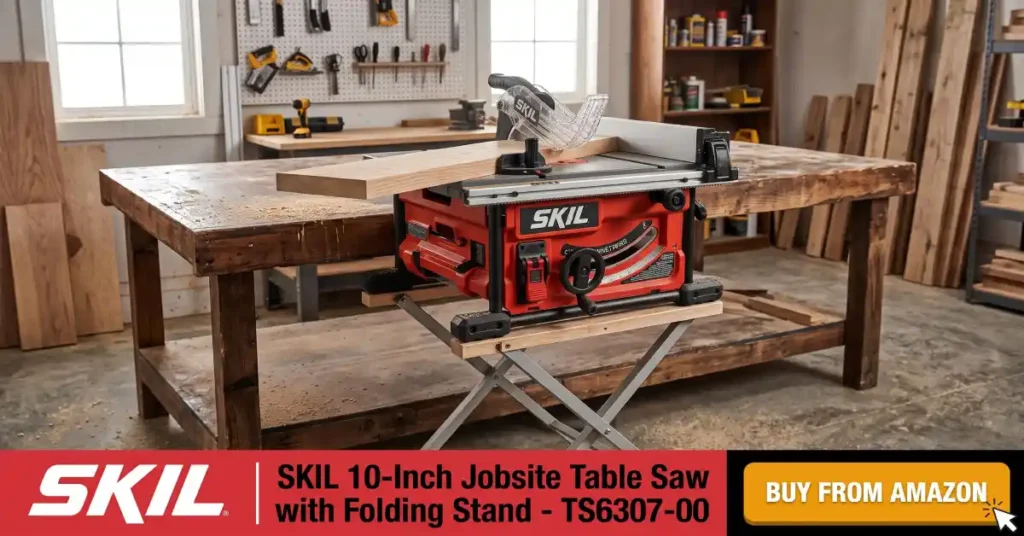
Best for: Budget buyers and DIYers who still want a real rack-and-pinion fence
Why it stands out: At well under $300, this is the only saw in its price bracket with a genuine rack-and-pinion fence, a feature normally reserved for saws costing twice as much. It’s earned a reputation in woodworking forums almost entirely through word of mouth rather than marketing, which is a meaningful signal in a category full of aggressive advertising.
Full specifications:
- Blade: 10 inches, 24-tooth carbide blade included
- Motor: 15-amp
- Rip capacity: 25-1/2 inches
- Depth of cut: 3.5 inches at 90 degrees, 2.5 inches at 45-degree bevel
- Bevel range: -2 to 47 degrees
- Stand: integrated foldable legs, no separate assembly required
- Fence: rack-and-pinion rail system
- Weight: approximately 50 lbs
Pros:
- Rack-and-pinion fence rarely found below $300
- Integrated folding legs eliminate a separate stand to store or lose
Con: The stock 24-tooth blade is a rip-only blade, so most buyers upgrade it immediately for smoother crosscuts
Who should buy it: A DIYer or budget-conscious contractor who wants accuracy without paying jobsite-flagship prices.
Verdict: The clearest value pick on this list, and the one to choose if price is your primary constraint.
3. SKILSAW SPT99T-01 8-1/4 Inch Portable Worm Drive Table Saw
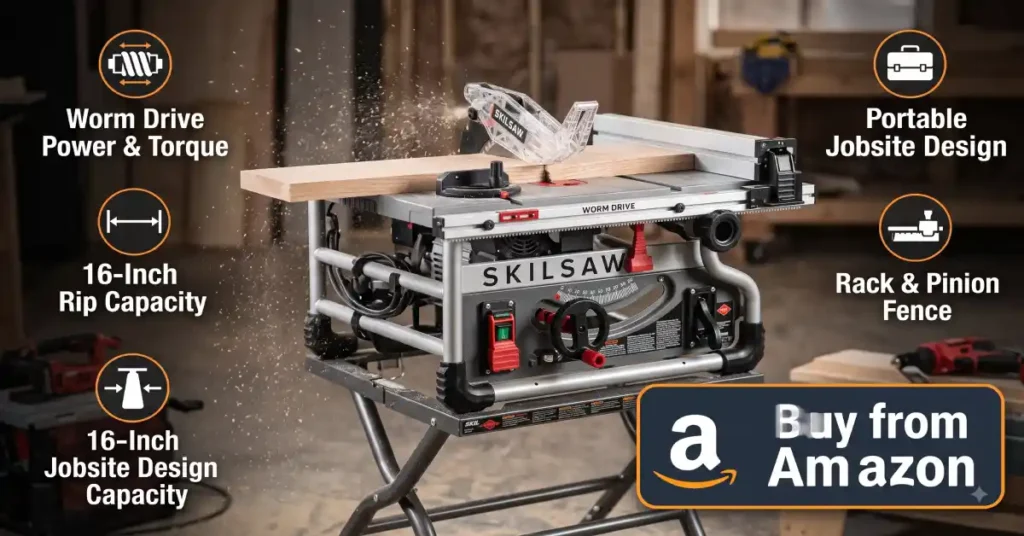
Best for: Framers and contractors who want worm-drive torque in a table saw format
Why it stands out: Worm drive gearing delivers more sustained torque at lower RPM than a standard direct-drive motor, which is exactly what framers already prefer in their circular saws. SKILSAW brought that same gearing into a table saw format here, paired with a Dual-Field motor designed to run cooler under repeated heavy cuts.
Full specifications:
- Blade: 8-1/4 inches
- Motor: 15-amp Dual-Field worm drive motor
- Rip capacity: 25 inches
- Depth of cut: 2-5/8 inches
- Max crosscut: up to 3x material in a single pass
- Fence: rack-and-pinion system
- Construction: all-metal housing
- Amazon rating: approximately 4.6 stars from 500+ ratings
Pros:
- Worm drive torque handles sustained ripping better than most direct-drive motors in this size class
- Lightweight, compact footprint compared to full 10-inch jobsite saws
Con: The smaller 8-1/4 inch blade means a shallower depth of cut than the 10-inch saws on this list
Who should buy it: A framer or trim carpenter who already trusts SKILSAW’s worm drive circular saws and wants that same feel in a table saw.
Verdict: A genuinely different tool from the rest of this list, and worth it specifically for buyers who value torque and durability over raw rip capacity.
4. DEWALT 15 Amp 8-1/4 in. Compact Portable Jobsite Table Saw (DWE7485)

Best for: Small home shops and contractors with limited storage or vehicle space
Why it stands out: It packs the same 15-amp motor and the same rack-and-pinion fence design as the full-size DWE7491RS into roughly half the footprint and weight. That combination is exactly what buyers are searching for when they want DEWALT’s accuracy without the bulk of a full jobsite saw.
Full specifications:
- Blade: 8-1/4 inches
- Motor: 15-amp, 5,800 RPM
- Rip capacity: 24-1/2 inches
- Depth of cut: up to 2-7/8 inches
- Weight: approximately 54 lbs
- Fence: rack-and-pinion telescoping fence
- Amazon rating: approximately 4.8 stars from 4,600+ ratings
Pros:
- Same proven rack-and-pinion fence as the larger DWE7491RS
- 5,800 RPM motor cuts cleanly through hardwood despite the compact size
Con: The smaller table surface means large sheet goods need extra outfeed support
Who should buy it: Anyone who wants DEWALT’s fence accuracy but doesn’t have the truck bed or storage space for a full 10-inch jobsite saw.
Verdict: The best compact pick on this list, and a smart choice for anyone who values storage space as much as cutting capacity.
5. RYOBI 15 Amp 10 in. Expanded Capacity Table Saw with Rolling Stand (RTS23)
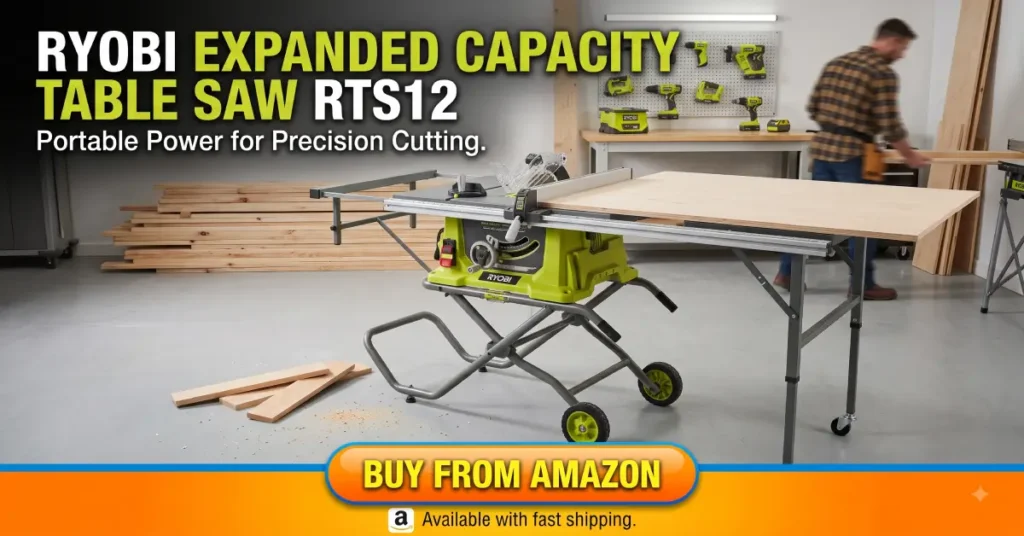
Best for: Homeowners and first-time buyers who want a genuine rolling stand at the lowest price point on this list
Why it stands out: It’s one of the few saws in the true budget category that still includes a rolling stand and a 15-amp motor rather than a bare benchtop unit, which is exactly the “budget but not a toy” search intent that drives most first-time table saw buyers. The steel roll cage design and integrated blade brake add durability and safety features that budget saws often skip.
Full specifications:
- Blade: 10 inches
- Motor: 15-amp, 5,000 RPM
- Frame: steel roll cage design
- Stand: folding stand with integrated wheels
- Table: cast aluminum top
- Safety: blade brake included
- Warranty: RYOBI 3-Year Manufacturer’s Warranty
- Included: blade, push stick, miter gauge, rip fence, guarding assembly, anti-kickback pawls
Pros:
- Lowest price point on this list with a genuine rolling stand and blade brake
- Backed by a 3-year manufacturer’s warranty, longer than several competitors offer
Con: The miter gauge fit is loose out of the box and needs tightening or an aftermarket replacement for precise cross-cuts
Who should buy it: A homeowner or hobbyist tackling occasional projects who wants a real rolling-stand saw without paying jobsite-contractor prices.
Verdict: The right pick if budget is your top priority and you’re not cutting hardwood daily.
6. BOSCH GTS15-10 10 Inch Portable Jobsite Table Saw with Gravity-Rise Wheeled Stand

Best for: contractors who move their saw in and out of a truck constantly and want the fastest possible setup and breakdown
Why it stands out: The Gravity-Rise Wheeled Stand is the standout feature here: a single-action, foot-pedal release that deploys or folds the stand without lifting the saw’s full weight. Combined with electronically regulated speed that holds RPM steady under load, this is one of the most job-site-practical designs in this category.
Full specifications:
- Blade: 10 inches
- Motor: 15-amp, 3,800 RPM, electronically regulated speed
- Rip capacity: 32-1/8 inches
- Stand: GTA50W Gravity-Rise Wheeled Stand with 8-inch treaded tires and foot-release pedal
- Fence: rack-and-pinion with color-coded index pins
- Safety: Smart Guard System with three-position riving knife, anti-kickback pawls, and barrier guard
- Additional features: convenience brake stops the blade in roughly three seconds, soft-start circuitry
Pros:
- Gravity-Rise stand is genuinely faster to set up and break down than a standard folding stand
- Smart Guard System and convenience brake add safety features some competitors lack
Con: At roughly 103 pounds with the stand, it’s one of the heavier saws on this list to lift in and out of a vehicle
Who should buy it: A contractor who sets up and tears down on multiple jobsites per week and values setup speed as much as cutting performance.
Verdict: The best stand design on this list, and a strong alternative to the DEWALT for anyone who prioritizes fast deployment.
7. SawStop Jobsite Saw PRO with Mobile Cart Assembly (JSS-120A60)

Best for: anyone who prioritizes finger-safety technology over price, whether professional or serious hobbyist
Why it stands out: SawStop’s patented flesh-detection braking system drops the blade below the table and stops it in a few milliseconds on skin contact, a feature no other saw on this list offers. The Jobsite Saw PRO pairs that safety system with a deeper table, an Active Dust Collection blade guard, and a versatile high-low fence built specifically for demanding jobsite use.
Full specifications:
- Blade: 10 inches
- Motor: 1.5 HP, 120V, 60Hz
- Rip capacity: 25-1/2 inches right of blade
- Depth of cut: 3-1/8 inches at 0 degrees
- Included: Active Dust Collection blade guard, riving knife, mobile cart, standard brake cartridge, hardware pack
- Safety: patented flesh-detection blade brake, three-position riving knife, anti-kickback pawls
- Mobility: mobile cart assembly included
Pros:
- Flesh-detection blade brake is a genuinely unique, life-changing safety feature not available on any other saw here
- Active Dust Collection blade guard and onboard tool storage are more thoughtfully designed than most competitors’
Con: Price is significantly higher than every other saw on this list, and replacing a triggered brake cartridge and blade adds an ongoing cost
Who should buy it: A professional or serious hobbyist who has decided that the safety premium is worth paying, especially anyone who’s had a close call on a previous saw.
Verdict: Not a saw for every budget, but the clear choice if flesh-detection safety technology is a priority rather than a nice-to-have.
How to Choose the Right Portable Table Saw
Rip capacity. This determines the widest board or sheet you can cut in one pass without extra support. If you regularly break down 4×8 plywood sheets, prioritize a saw with at least 30 inches of rip capacity, like the DEWALT DWE7491RS or the Bosch GTS15-10.
Motor power and RPM. Most saws in this category run 15-amp motors, which is close to the maximum a standard household circuit can handle. Beyond amperage, RPM affects cut smoothness: higher RPM generally means a cleaner cut in thinner material, while worm drive designs trade RPM for sustained torque in thicker stock.
Fence system. A rack-and-pinion fence is the single most important upgrade over a basic clamp-style fence, since it stays parallel to the blade and allows fast, precise micro-adjustments. Every saw on this list except the base RYOBI uses some version of this system.
Stand type. Rolling stands, gravity-rise stands, and integrated folding legs each solve the portability problem differently. If you set up and break down frequently, a gravity-rise design like Bosch’s saves real time over a standard folding stand.
Weight. Heavier saws are generally more stable during cuts but harder to load into a vehicle alone. If you’re a one-person operation loading and unloading daily, weigh that tradeoff carefully against stability.
Safety features. Riving knives, anti-kickback pawls, and blade guards are standard across every reputable saw in this category. SawStop’s flesh-detection brake is the only technology here that goes meaningfully beyond that baseline.
Dust collection. A dedicated dust port that connects to a shop vac makes a real difference for indoor or enclosed jobsite work. Check port size and compatibility with your existing vacuum before buying.
Warranty and support. Warranty terms vary significantly by brand. RYOBI’s 3-year coverage is longer than several competitors, while established brands like DEWALT and Bosch generally offer more widespread service center access.
Table size and material support. A larger table surface supports material better during a cut, which matters more with sheet goods than with dimensional lumber. Compact benchtop saws trade this away for portability.
Assembly and setup time. Most saws in this category ship mostly assembled, but stand assembly and fence calibration out of the box vary. Budget an hour for initial setup regardless of which saw you choose.
Safety and Real-World Use
A portable table saw is one of the more dangerous tools in a typical shop or jobsite, regardless of price point or safety features. Every saw on this list requires the same fundamental precautions.
Before using any portable table saw:
- Always use the riving knife and blade guard unless a specific cut genuinely requires their removal, and reinstall them immediately afterward.
- Use a push stick for any cut that brings your hand within a few inches of the blade. Never freehand a narrow rip.
- Check that the fence is parallel to the blade before every session, especially after transporting the saw.
- Wear eye and hearing protection every time, not just for the first few uses.
- Stand to the side of the blade’s cutting line, not directly behind it, to avoid kickback injury.
- Never reach over a spinning blade to retrieve an offcut; wait until the blade has fully stopped.
- Unplug the saw before changing blades or performing any maintenance.
And a reminder on scope: these saws are built for jobsite and home workshop use, not continuous industrial production. Even the SawStop’s flesh-detection brake is a last line of defense, not a substitute for using the guard, riving knife, and push stick correctly on every cut.
Best Use Cases
Deck and framing contractors. A wide rip capacity and a fast-deploying stand, like the DEWALT DWE7491RS or Bosch GTS15-10, matter more here than raw compactness.
Cabinet and finish carpentry. Accuracy from a rack-and-pinion fence matters most, since repeated precise rip cuts are the core of the work.
Home renovation DIYers. The RYOBI RTS23 or SKIL TS6307-00 covers most home projects without the cost of a full contractor-grade saw.
Small shop and garage woodworkers. The DEWALT DWE7485‘s compact footprint solves the storage problem that a full 10-inch saw creates in a small space.
Framers who already run worm-drive circular saws. The SKILSAW SPT99T-01 extends that same tool feel into a table saw format.
Safety-first professionals and hobbyists. The SawStop Jobsite Saw PRO is worth the premium for anyone who has decided flesh-detection technology is non-negotiable.
Occasional or first-time users. Start with a budget saw like the RYOBI or SKIL before investing in a premium model, since your cutting needs may change once you understand your actual usage pattern.
Frequently Asked Questions
What size portable table saw do I need?
Most homeowners and contractors are well served by a 10-inch blade with 25 to 32 inches of rip capacity. If you regularly break down full plywood sheets, prioritize the higher end of that rip capacity range. If your work is mostly dimensional lumber and trim, an 8-1/4 inch compact saw like the DEWALT DWE7485 is usually enough.
Is a portable table saw as accurate as a stationary one?
A well-built portable saw with a rack-and-pinion fence, like several models on this list, can be nearly as accurate as an entry-level stationary saw for most tasks. Where portable saws fall short is sustained rigidity during heavy, repeated cuts, since stationary cabinet saws use a heavier trunnion and base that resists vibration better over long sessions.
How much rip capacity do I actually need?
For breaking down a standard 4×8 sheet of plywood in half lengthwise, you need at least 24 inches of rip capacity. For ripping a full sheet down to a narrower final width, 30 to 32 inches gives more flexibility without needing to flip the material mid-cut.
Are worm drive table saws better than direct-drive models?
Neither is objectively better; they suit different work. Worm drive designs like the SKILSAW SPT99T-01 deliver more sustained torque at lower RPM, which framers often prefer for thick or dense material. Direct-drive saws typically run at higher RPM, which usually produces a smoother cut in thinner sheet goods.
Is a SawStop table saw worth the extra cost?
That depends on how you weigh the cost of the flesh-detection safety system against the price premium. For professionals cutting daily or hobbyists who’ve had a close call before, many consider the safety technology worth the investment. For occasional, careful use with proper guards and push sticks, a standard saw with good safety features can also be used safely.
Can a portable table saw handle plywood and sheet goods?
Yes, provided the rip capacity and table size are adequate for the sheet. Saws with wider tables and higher rip capacity, like the DEWALT DWE7491RS or Bosch GTS15-10, handle full sheets more comfortably than compact benchtop models, which may need extra outfeed support.
How often should I replace the blade on a portable table saw?
Most stock blades that ship with these saws are general-purpose and benefit from an upgrade fairly quickly, especially rip-only blades like the one included with the SKIL TS6307-00. Beyond that initial upgrade, replace or sharpen a blade when you notice burning, tear-out, or increased motor strain during normal cuts, which typically happens well before the blade looks visibly dull.
A Final Note on Buying These Saws
Prices, stock, and exact specifications on Amazon listings change frequently, sometimes week to week. Every spec in this guide was pulled directly from current or recent listing content and manufacturer documentation, but we recommend opening each product page before you buy to confirm current pricing, availability, and any recent changes to included accessories.
This article contains references to third-party Amazon listings for informational and comparison purposes. Always verify current pricing, availability, and safety documentation directly on the manufacturer’s listing before purchasing. Consult the product manual and follow all manufacturer safety instructions before operating any power tool.
Table of Contents