

If you’ve been shopping for a cordless chainsaw, chances are Milwaukee’s M18 lineup has come up more than once. This Milwaukee M18 Chainsaw Review focuses specifically on the Milwaukee 2727-20 M18 Fuel 16″ chainsaw — the tool-only version, sold without a battery or charger. It’s the same saw at the heart of Milwaukee’s newer 2727-21HD kit, just without the battery and charger bundled in, which makes it a different buying decision than a full kit and worth reviewing on its own terms. We’ll also touch on the compact M18 Fuel top-handle chainsaw (2826-20C) and the larger dual-battery 20″ saw for context, for readers weighing the broader M18 chainsaw family.
Battery-powered chainsaws have come a long way from underpowered yard trimmers. Milwaukee’s Fuel line pairs a brushless motor with its high-output battery packs to chase gas-saw performance without the pull cord, fuel mixing, or exhaust fumes. That’s the appeal — but “gas-like” claims are easy to print on a box and harder to verify in your own backyard. This review breaks down what the M18 chainsaw actually does well, where it falls short, and who should (and shouldn’t) buy the tool-only version specifically.
Who this chainsaw is for: current M18 tool owners who already have batteries and a charger sitting in the garage, homeowners with a handful of trees, property owners doing routine limbing and firewood prep, and light landscaping or arborist work where all-day gas-saw stamina isn’t required. If that sounds like you, keep reading — you’ll get a full breakdown of specs, what’s actually in the box, real-world performance, oil and maintenance guidance, honest pros and cons, and a comparison against gas saws and other M18 Fuel chainsaw variants.
Important: This Is the Tool-Only Version
Before anything else, it’s worth being upfront about what you’re buying with this specific listing. The Milwaukee 2727-20 is sold as bare tool only — no battery and no charger included. If you don’t already own compatible M18 batteries and a charger, you’ll need to budget for those separately before this saw will run at all. This is different from the 2727-21HD kit, which bundles a Redlithium High Output HD12.0 battery and rapid charger for a higher combined price.
For existing Milwaukee M18 owners, buying tool-only is usually the smarter move — you’re not paying for a battery and charger you already have duplicates of. For someone starting from zero with no M18 batteries, it’s worth running the math: a tool-only saw plus a separate High Output battery and charger can end up costing close to (or sometimes more than) simply buying the bundled kit, so check current pricing on both before deciding.
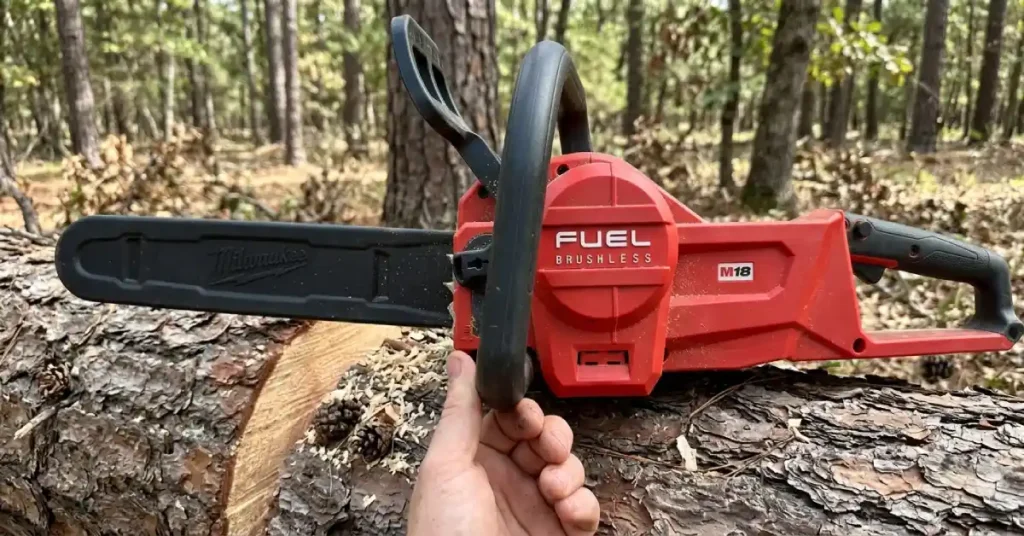
Key Specs and Features Overview
Before diving into how it performs, here’s what you’re actually buying with the 2727-20 listing.
| Spec | Milwaukee M18 Fuel 16″ Chainsaw, Tool-Only (2727-20) |
|---|---|
| What’s included | Chainsaw, 16″ Oregon bar and chain, scrench. No battery, no charger. |
| Bar length | 16 inches (Oregon bar and chain) |
| Motor | Milwaukee Powerstate brushless |
| Battery | Not included — a battery-powered 18-Volt Lithium-Ion Battery from the M18 system is required; High Output packs (XC8.0 or HD12.0) recommended |
| Voltage | 18V |
| Chain speed | Roughly 12.7 meters per second (about 2,500 ft/min) unloaded |
| Working weight (bare tool) | Around 10 lbs without a battery installed; roughly 14 lbs once a 12.0Ah High Output battery is added |
| Battery capacity/watt hours | A 12.0Ah High Output pack at 18V works out to roughly 216 watt hours of usable energy per charge |
| Chain pitch/gauge | 3/8″ low profile, 0.043″ gauge |
| Oiling | Automatic bar and chain oiler keeps the chain lubricated throughout the cut |
| Chain tensioning | External, tool-assisted (screwdriver + wrench combo tool, aka “scrench”) |
| Safety features | Chain brake, front hand guard |
| Warranty | 3-year limited tool warranty |
| Recommended oil | Bar and chain oil (any quality bar oil; Milwaukee sells its own branded chainsaw oil) |
The single biggest reason to consider this tool-only saw over buying a full kit — or over a comparable battery competitor — is the M18 platform itself. If you already own M18 drills, impact wrenches, or other Milwaukee cordless outdoor power tools, you can run this chainsaw off batteries and a charger you already own, which is exactly what the 2727-20 listing is built for.
That compatibility is a real, practical cost-saving factor that’s easy to overlook when comparing specs sheet-to-sheet — but it only pays off if you’re not starting your battery collection from scratch.
Design and Build Quality
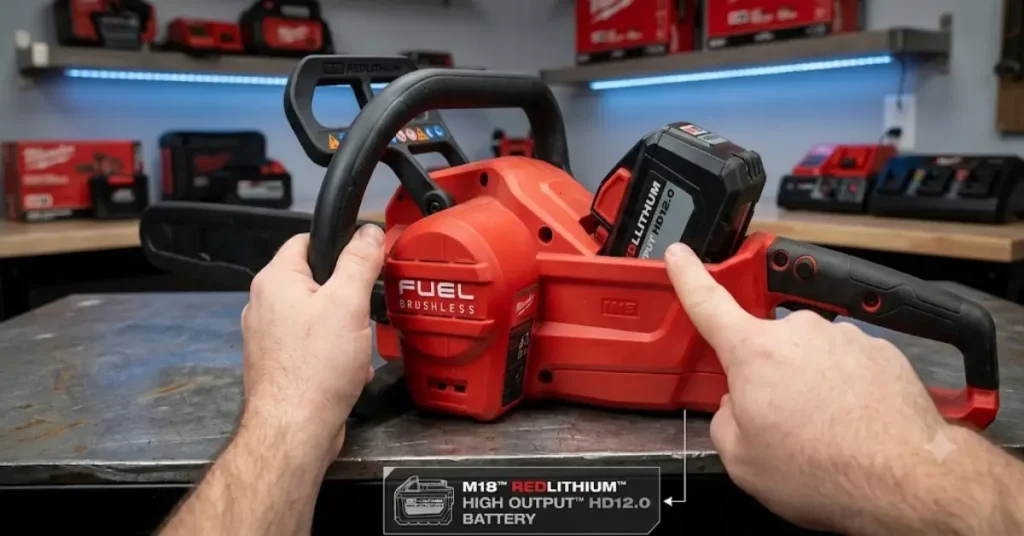
Pick this saw up, and the first thing you’ll notice is the balance. Milwaukee positions the battery close to the rear handle, which keeps weight centered instead of hanging off the back like some competing designs. That matters more than it sounds — a saw that’s front-heavy or back-heavy tires your wrist and forearm out much faster over an afternoon of limbing.
The rear handle and trigger area use a rubber-textured overmold that stays grippy even with gloves on or when your hands get a little sappy. The trigger itself has a short, direct travel with minimal dead zone before the chain engages, which gives you more precise control during finish cuts than a mushier trigger would.
Build quality lands closer to Milwaukee’s professional-grade line than to a homeowner-tier tool. The housing plastics are thick, and the metal components — the bar mounting hardware, the bucking spikes, the chain brake lever — feel like they’re built to survive a drop onto a driveway rather than a controlled unboxing photo. That said, it’s still a plastic-bodied cordless tool, not a magnesium-cased pro gas saw, so treat it with the same care you’d give any battery power tool.
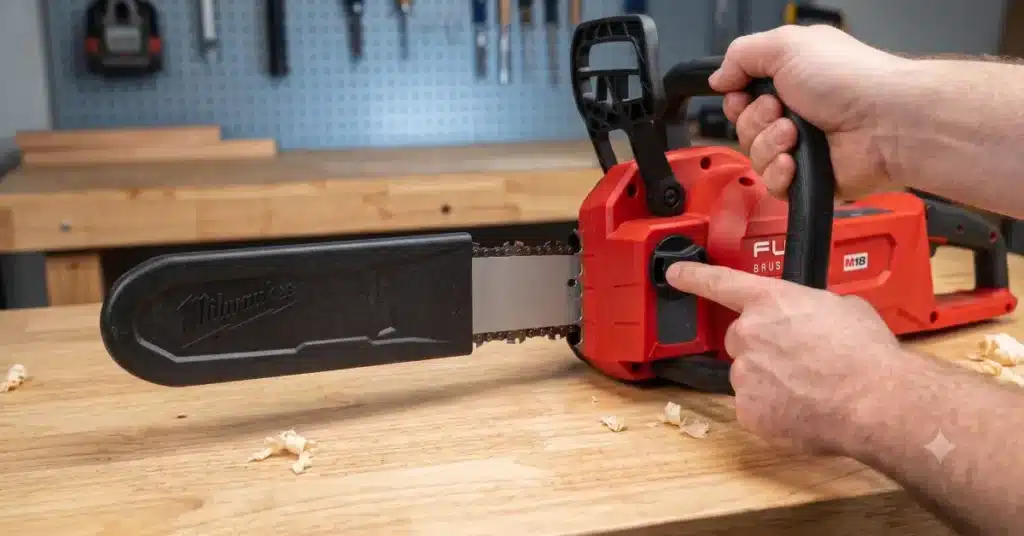
Chain access and tensioning is straightforward but not tool-free — you’ll use the included scrench (a combined screwdriver + wrench tool) to loosen the bar nuts and adjust tension, which is standard for this class of saw and honestly preferable to some “tool-free” tensioners that loosen themselves under vibration.
Like other saws in the M18 Fuel chainsaw family, this platform is built around field-ready touches — metal bucking spikes for stable, controlled bucking cuts, and (on the top handle variants especially) a lanyard loop for secure attachment during aloft or climbing work.
Milwaukee M18 Fuel Chainsaw Power and Runtime
This is the section most buyers actually care about: does an M18 fuel chainsaw really cut like gas?
Limbing and small branches. This is where the saw shines. Instant throttle response (Milwaukee’s spec sheets claim under one second to full RPM) means you’re not waiting on the chain to spool up between cuts, which speeds up repetitive limbing work noticeably compared to a gas saw you’re feathering the throttle on.
Firewood rounds. On seasoned or green hardwood rounds in the 6–12 inch range, the 16″ bar has no trouble bucking through in a couple of seconds per cut. Once you get into larger, harder rounds — especially dense, dry oak or similar hardwoods — you’ll notice the cut slows and the battery drains faster. It’s still capable, just not tireless.
Light felling. For small-diameter trees (say, under 12–14 inches), the saw handles felling cuts fine. It is not the tool for taking down large mature trees all day; that’s genuinely a job better suited to a full-size gas saw or a professional arborist with commercial equipment.
Realistic battery runtime. Milwaukee’s own testing claims up to 150 cuts per charge on a 12.0Ah High Output battery (roughly 216 watt hours of battery capacity) in nominal conditions (cutting through dimensional lumber, not full-diameter rounds). In practical yard use, that translates to roughly one to two hours of intermittent limbing and light bucking work — plenty for a weekend cleanup session, but you’ll want a spare battery on hand for a full day of firewood processing or storm cleanup.
Compared against the 12″ top handle M18 Fuel chainsaw (2826-20C, part of the Milwaukee M18 Fuel 2826 series) and the higher-capacity M18 Dual Battery Chainsaw (the 20″ model 2827), the 16″ model in this review sits in the sweet spot for ground-based homeowner and light-property-maintenance work.
The top handle variant trades bar length and raw cutting capacity for a lighter, more maneuverable saw designed for one-handed use in a bucket truck or on a climbing line — not something most homeowners need.
The M18 Dual Battery Chainsaw exists for buyers who want maximum bar length, sustained power, and runtime, and it adds selectable power modes not found on the single-battery 2727-20: a Standard Mode tuned for longer runtime and cooler operation, and a Peak Power Mode for maximum cut performance in dense hardwoods.
The 2727-20 reviewed here runs at a single, consistent power level rather than offering selectable modes, which keeps things simple but means you don’t get that same on-the-fly runtime-versus-power trade-off.
Battery System and Charging
The M18 battery ecosystem is arguably Milwaukee’s biggest competitive advantage, and it’s especially relevant here since the 2727-20 doesn’t include a battery or charger at all — you’re buying directly into that ecosystem, or relying on one you already have.
- You must supply your own battery and charger. This tool-only listing will not run out of the box. Factor a battery-powered pack (and charger, if you don’t have one) into your total cost before purchasing.
- Recommended battery size: For this chainsaw specifically, Milwaukee recommends its High Output packs (HD12.0 or XC8.0) rather than standard Redlithium packs — the higher output batteries are built to sustain the current draw a chainsaw motor demands without overheating or throttling performance. A standard (non-High-Output) M18 battery will physically fit but will likely underperform and drain faster under chainsaw-level load.
- Battery capacity and watt hours: An 8.0Ah High Output battery delivers roughly 144 watt hours, while the 12.0Ah pack delivers roughly 216 watt hours — the higher watt-hour rating is what translates into more cuts per charge and better sustained power under load.
- Charge times: A High Output HD12.0 battery typically takes roughly an hour to charge on Milwaukee’s rapid chargers.
- Managing multiple batteries: If you’re doing more than an hour of continuous cutting, plan on rotating at least one spare battery. Many M18 owners already have 2–3 batteries from other cordless outdoor power tools and impact wrenches, which is exactly where buying tool-only pays off versus paying kit prices for a battery and charger you’d be duplicating.
- Weight and fatigue: The 12.0Ah High Output battery is the heaviest option Milwaukee offers, and it’s a meaningful chunk of this saw’s working weight once installed. An 8.0Ah pack shaves some weight at the cost of some battery runtime and peak sustained power — a reasonable trade for lighter users or shorter sessions.
Chain, Bar, and Milwaukee Chainsaw Oil
The saw ships with an Oregon-branded bar and chain, which is a sensible choice — Oregon chains are widely available at hardware stores, so replacement and sharpening supplies are never hard to find. The stock chain uses a 3/8″ low-profile pitch with a 0.043″ gauge, common sizing that keeps replacement chain costs reasonable.
Milwaukee chainsaw oil basics:
- Use a dedicated bar and chain oil, not motor oil or hydraulic fluid — the auto-oiler is calibrated for the tackiness and viscosity of proper chain oil.
- Check the oil reservoir before every session; running the saw dry, even briefly, accelerates bar and chain wear.
- In hot weather, a summer-weight bar oil flows better; in cold weather, a lighter-viscosity or biodegradable oil prevents sluggish oiling on startup.
- Common complaints in this saw category involve oil residue around the bar mount after storage — this is normal gravity-fed seepage, not necessarily a leak, but wiping the saw down and storing it upright reduces mess.
Maintenance basics:
- Sharpen the chain every few tanks (batteries, in this case) of moderate use, or immediately if you notice the saw pulling to one side or producing fine dust instead of clean chips.
- Clean the bar groove and sprocket area regularly — sawdust packed into the bar rail is one of the most common causes of poor chain tension retention.
- Store the saw with the chain brake engaged and the bar guard on, in a dry location.
Noise, Vibration, and Ease of Use
One of the most immediately noticeable differences from a gas saw is noise. This M18 chainsaw runs meaningfully quieter than a comparable gas chainsaw — you can hold a conversation nearby without shouting, and it’s far more neighbor-friendly for suburban properties. It’s still a chainsaw, so hearing protection is still recommended, but the reduction compared to a 2-stroke gas engine is real and welcome.
Vibration at the handles is noticeably lower than a gas saw as well, which reduces hand fatigue on longer sessions. The chain brake engages positively, and the front hand guard is easy to trip in a kickback scenario, which is the main safety mechanism you’re relying on with any chainsaw, corded or not.
For beginners, this is one of the more approachable chainsaws to learn on: no choke, no primer bulb, no flooding the engine, no pull-start technique to master. Insert a charged battery, engage the safety, pull the trigger. That simplicity meaningfully lowers the intimidation factor for someone who’s never run a chainsaw before — though it doesn’t replace proper safety training, protective gear, or basic chainsaw handling instruction.
Use Cases: Who Is the Milwaukee M18 Chainsaw For?
Homeowners with trees in a large yard. This is the core buyer. Routine limbing, downed branch cleanup after storms, and occasional small-tree removal are all well within this saw’s comfort zone.
Landlords and property managers. If you’re maintaining multiple properties and already carry M18 tools in the truck, adding this chainsaw to the kit means one more battery platform, not a whole new fuel and maintenance routine to manage across sites.
Light professional landscaping and arborist tasks. For crews doing routine trimming and small-tree work, the instant-start convenience and lower noise are genuine productivity and client-relations wins. Full-time production tree felling or all-day commercial land clearing is where this saw (and cordless saws generally) starts to struggle against gas.
Existing M18 tool owners. If your garage already has M18 batteries and chargers, this is close to a no-brainer add — you’re paying largely for the tool itself, not rebuilding a battery ecosystem.
Pros and Cons
Pros
- No gas, no oil mixing, no ethanol-related carburetor issues to troubleshoot.
- Instant push-button start with no pull cord or choke.
- Noticeably quieter and lower-vibration than a comparable gas saw.
- Strong torque and consistent power under load thanks to the brushless motor and Redlink Plus electronics.
- Shares batteries and chargers across the entire M18 tool platform — a real cost advantage for existing Milwaukee owners.
- Auto-oiler and tool-assisted tensioning keep routine maintenance simple.
Cons
- No battery or charger included — this tool-only listing adds real cost if you don’t already own M18 batteries, and it won’t run at all straight out of the box.
- Battery cost adds up fast if you’re starting from zero — a High Output 12.0Ah pack alone can cost nearly as much as some budget gas saws.
- Fully loaded with the 12.0Ah battery, the saw is on the heavier side for its class, which shows up over long sessions.
- Runtime, while solid for yard work, isn’t a substitute for all-day production cutting on very large hardwood logs.
- Not designed to replace a full-size professional felling saw for large-diameter tree work or commercial logging.
- Occasional minor bar oil residue during storage, which is manageable but worth knowing about upfront.
Milwaukee M18 Chainsaw vs. Alternatives
| Factor | M18 Fuel 16″ (2727-20) | Comparable Gas Powered Chainsaw (~40cc class) | M18 Fuel Top Handle (2826-20C) |
|---|---|---|---|
| Startup | Instant, push-button | Pull-start, choke/primer | Instant, push-button |
| Chain speed | ~12.7 m/s unloaded | Varies by engine, typically comparable or slightly higher | Similar class, slightly lower given shorter bar |
| Noise | Moderate | High | Moderate |
| Maintenance | Battery care, chain care | Carburetor, spark plug, fuel mix | Battery care, chain care |
| Runtime style | Bursts, swap batteries | Continuous, refuel to extend | Shorter bursts, lighter saw |
| Best for | Yard work, firewood, small felling | All-day production cutting, large trees | Precision limbing, aloft/climbing work |
| Portability | Moderate working weight, no fuel to carry | Heavier with fuel, but unlimited runtime with more gas | Lightest of the three |
| Noise for neighbors | Better tolerated | Least tolerated | Better tolerated |
The honest takeaway: a gas-powered chainsaw still wins for sustained, all-day, large-diameter cutting where you can just top off the tank and keep going. The M18 Fuel chainsaw wins for convenience, noise, and simplicity in the property-maintenance and homeowner use case — and it’s also a legitimate option for professional landscapers who want to cut noise and fuel-handling hassle out of routine daily work, which is the majority of buyers reading this review.
Durability, Reliability, and Long-Term Ownership
Milwaukee backs the 2727 chainsaw with a 3-year limited tool warranty, which is competitive for this class and reflects reasonable confidence in the build. In practice, most user-reported issues in this category tend to center on chain and bar wear from insufficient oiling or tensioning — not motor or electronics failures — which reinforces how much routine maintenance affects long-term reliability with any chainsaw, cordless or gas.
Milwaukee’s broader reputation in the power tool space is built on its professional and trade-focused product lines, and the M18 Fuel outdoor power equipment range has matured over several product generations at this point, with the HD12.0 battery and Redlink Plus electronics representing later refinements over the original tool-only 2727-20 release.
Setup, Maintenance, and Safety Tips
- Unboxing and initial setup. Since this listing doesn’t include a battery or charger, confirm you have a compatible M18 High Output battery and charger on hand before your first cut. Charge the battery fully before first use.
- Installing bar and chain. Use the scrench to remove the bar cover, seat the chain around the bar and sprocket with the cutting edges facing the correct direction, then reinstall the cover and adjust tension until the chain sits snug against the bar but still pulls freely by hand.
- Adding oil. Fill the bar oil reservoir before every session; check the sight window periodically during longer cutting sessions.
- Starting and stopping safely. Engage the chain brake before inserting the battery, disengage only when you’re ready to cut, and always engage the brake again before setting the saw down or walking with it.
- Transporting the saw. Use the included bar guard/scabbard, and remove the battery for extended transport or storage.
Ongoing maintenance tips: sharpen at the first sign of dull cutting (fine sawdust instead of chips is the tell), clean sawdust out of the bar groove regularly, and store the battery separately from the tool in a moderate-temperature location to preserve long-term battery health.
Pricing, Value, and Who Should Buy
Pricing varies by retailer, but as a general guide: the tool-only 2727-20 reviewed here typically runs in the low-to-mid $300s on its own — no battery or charger included. A full kit version, such as the newer 2727-21HD with a 12.0Ah High Output battery and rapid charger bundled in, typically lists noticeably higher, often close to $500, since you’re paying for the battery and charger as part of the price. The top handle 2826-20C tool-only runs roughly $300–$350, and the 20″ dual-battery kit sits meaningfully higher given the extra battery and bar length.
If you already own an M18 battery and charger, buying tool-only like this listing is almost always the better value — you’re only paying for the saw itself. If you’re starting from zero, add up the tool-only price plus a High Output battery and charger separately and compare that total against a bundled kit price before deciding which route is actually cheaper; depending on current promotions, the math can go either way.
Against a comparable 40–45cc gas saw, the upfront cost is often similar once you factor in a battery and charger — but you’re not budgeting for gas, 2-stroke oil, air filters, spark plugs, or carburetor service over the tool’s life, which narrows the total cost of ownership gap over time, especially for anyone who already owns M18 batteries.
Great buy if:
- You already own M18 batteries and a charger and just need the tool.
- Your typical job is yard maintenance, firewood prep, or occasional small-tree work.
- You value low noise, instant starts, and minimal maintenance over raw all-day runtime.
Consider other options if:
- You have no existing M18 batteries or charger — compare the total cost of tool-only-plus-battery against a bundled kit before buying this listing specifically.
- You need to fell and process large-diameter hardwood regularly.
- You’re a full-time professional whose income depends on all-day cutting capacity.
Frequently Asked Questions
Is the Milwaukee M18 Fuel chainsaw powerful enough to replace a gas chainsaw?
For most homeowner and light-property tasks — limbing, firewood rounds, small-tree felling — yes. For sustained, all-day, large-diameter professional cutting, a gas saw still has the runtime edge.
How long does the battery last on the M18 chainsaw?
With a 12.0Ah High Output battery, expect roughly one to two hours of realistic intermittent yard work, or up to around 150 cuts per charge in Milwaukee’s lumber-based testing.
What type of oil does the Milwaukee M18 chainsaw use?
A standard bar and chain oil, delivered through the saw’s automatic oiler. Milwaukee sells its own branded chainsaw oil, though any quality bar oil suited to your climate works.
Can I use other M18 batteries with the 2727-20 chainsaw?
Yes — the saw is compatible with the broader M18 battery lineup, though Milwaukee recommends its High Output packs for best sustained performance under chainsaw-level current draw.
Should I buy the tool-only 2727-20 or a Brushless Cordless Chainsaw Kit?
If you already own M18 batteries and a charger, the tool-only 2727-20 is almost always the better value. If you’re new to the M18 system, a bundled Brushless Cordless Chainsaw Kit (like the 2727-21HD) that includes a battery and charger can work out cheaper than buying everything separately — compare current pricing on both before you decide.
Is the Milwaukee M18 Fuel top handle chainsaw (2826-20C) better for tree work?
It’s better for aloft or climbing-style precision work where a lighter, one-handed-capable saw matters. For ground-based yard and firewood work, the 16″ saw in this review is the more practical, higher-capacity choice.
How often should I sharpen the chain on my M18 chainsaw?
As a rule of thumb, check sharpness every couple of batteries of moderate use, and sharpen immediately if you notice fine dust instead of clean chips or the saw pulling to one side.
Can the Milwaukee M18 chainsaw handle hardwood logs?
Yes, within reason — it cuts through hardwood rounds effectively, though very large, dense, dry hardwood will slow cutting speed and drain the battery faster than softer or smaller-diameter wood.
Do I need a special charger for the M18 chainsaw battery?
No — it uses the same M18 rapid chargers as the rest of Milwaukee’s M18 tool lineup, and kits typically include a compatible charger.
Does the Milwaukee 2727-20 come with a battery and charger?
No. The 2727-20 is a bare tool — it ships with the saw, the 16″ Oregon bar and chain, and a scrench, but no battery and no charger. You’ll need to buy an M18 High Output battery and a compatible charger separately if you don’t already own them.
Is this chainsaw safe for a beginner to use?
It’s more approachable than a gas saw thanks to instant starts and lower vibration, but it’s still a chainsaw — proper protective gear, chain brake awareness, and basic safety training are still essential regardless of experience level.
Conclusion: Final Verdict on the Milwaukee M18 Chainsaw
This Milwaukee M18 Chainsaw Review comes down to a fairly clear verdict: the M18 Fuel 16″ chainsaw is an excellent fit for homeowners, property managers, and light professional users who want gas-like cutting power without gas-engine hassle — especially if you’re already invested in the M18 battery platform. It handles limbing, firewood processing, and small-tree work confidently, runs quieter and smoother than a comparable gas saw, and keeps maintenance simple.
It’s not the right tool if your work demands all-day, large-diameter production cutting — that’s still gas-saw territory. But for the vast majority of readers comparing a Milwaukee battery chainsaw M18 option against a traditional gas saw for yard and property use, this is one of the more capable, well-built choices in its class. Weigh your typical workload, your existing tool investment, and your budget for batteries, and you’ll have a clear answer on whether this is the saw for you.
Table of Contents