

The best DeWalt reciprocating saws in 2026 combine power, runtime, and blade control so contractors and homeowners can cut through wood, nail-embedded lumber, and metal with confidence. Whether you are tearing out a wall, pruning overgrown branches, or cutting through pipe in a tight crawl space, the right saw makes the job faster and safer.
DeWalt has earned its spot at the top of most contractors’ tool bags for a simple reason: the ecosystem works. If you already own a DeWalt cordless drill, circular saws, or other power tools running on the same 20V battery, adding a DeWalt Cordless Reciprocating Saw to that lineup means one less charger to carry and one more tool that just works when you grab it. That single battery becomes a shared power source across your whole kit instead of a one-off purchase. DeWalt also backs its saws with strong parts availability and service centers, which matters when a tool takes a beating on a job site for years.
In this guide, we review five DeWalt reciprocating saws that consistently rank as top sellers and get strong reviews from real users, from weekend DIYers to full-time contractors. You will find a corded option, three cordless 20V MAX models at different price and power points, and a compact one-handed saw built for tight spaces. People shop for tools like this in a lot of places these days, not just Google. You might be watching teardown videos on YouTube, scrolling tool boards on Pinterest, comparing specs on Amazon, or asking an AI assistant which saw fits your situation. This guide is built to answer that question no matter where you found it.
Comparison Table: Best DeWalt Reciprocating Saws Side By Side
Best DeWalt Reciprocating Saws at a Glance
| Model | Power Type | Motor Type | Size Class | Best For | Strength | Limitation |
|---|---|---|---|---|---|---|
| DWE305 | Corded | Brushed | Full-size | Heavy demolition without battery limits | 12-amp power with unlimited runtime | Cord limits mobility |
| DCS380B | Cordless 20V MAX | Brushed | Full-size | Entry-level cordless for existing 20V owners | Low tool-only price | Shorter runtime than XR models |
| DCS386B | Cordless 20V MAX XR | Brushless | Full-size | Pro-grade all-around cutting | Fast cuts and long runtime | Higher price than base models |
| DCS369B | Cordless 20V MAX ATOMIC | Brushless | One-handed | Tight spaces, overhead, electrical, plumbing | Extremely compact and lightweight | Smaller stroke limits heavy demolition |
| DCS388B | Cordless 20V MAX XR | Brushless | Full-size | Heavy demolition and metal cutting | Most powerful cordless option here | Premium price and higher battery draw |
Pricing, ratings, and availability change often on Amazon. Confirm current details on each product page before buying.
DeWalt Reciprocating Saw Basics: What To Know Before You Buy
Before jumping into the picks, it helps to understand the handful of factors that actually separate a good reciprocating saw from a great one for your specific job.
Corded vs Cordless Reciprocating Saws
Corded reciprocating saws plug directly into an outlet or generator as their power source, so they never run out of power mid-cut. That makes them a strong choice for long demolition sessions where you do not want to stop and swap batteries. The tradeoff is mobility. You are tied to an outlet and, on bigger job sites, an extension cord.
Cordless, battery powered reciprocating saws run on rechargeable batteries, so you can move freely around a house, up a ladder, or into a crawl space without worrying about a cord catching on debris. Modern 20-Volt MAX Li-Ion batteries have closed much of the power gap with corded tools, but runtime is still limited by battery capacity, and you will want at least one spare battery for a full day of work.
Brushed vs Brushless Motors
Brushed motors are the traditional design. They are reliable and usually cost less upfront, but the physical brushes create friction and heat, which wears them down over time and reduces efficiency.
Brushless motors use electronic controls instead of physical brushes. That means less friction, less heat, and more of the battery’s energy actually going into cutting power. Brushless saws also tend to last longer under heavy use and squeeze more run time out of the same battery. If you are on a job site daily, a brushless model is usually worth the extra cost.
Full-Size vs One-Handed Reciprocating Saws
Full-size reciprocating saws are built for maximum cutting power and longer stroke lengths, which makes them the right tool for demolition, framing, and thick material. They are heavier and need two hands to control properly.
One-handed, compact reciprocating saws trade some raw power for size and weight. They shine in tighter spaces, overhead work, and jobs where you need one hand free to hold a pipe, a wire, or a ladder. Many of these compact models are light enough to clip to a tool belt alongside a cordless drill, so they are always within reach between cuts. Electricians and plumbers often reach for a compact saw first and only pull out a full-size saw when the cut demands it.
Stroke Length, Speed, And Cutting Performance
Stroke length is how far the blade travels back and forth with each cycle, and strokes per minute (SPM) is how fast it does that. Longer stroke length generally means faster material removal, especially in wood, while a well-tuned SPM range gives you control in metal and finer cuts. Variable speed triggers let you slow down for precision cuts and speed up for aggressive demolition, which is why almost every serious reciprocating saw includes one.
Some higher-end models also add orbital action, which moves the blade in a slight elliptical pattern instead of a straight line. Switching between cutting mode settings lets you flip orbital action on for faster wood removal and off for cleaner, more controlled cuts in metal or when you are working with a specific blade length that needs a straighter stroke.
Safety Essentials For Reciprocating Saw Users
A reciprocating saw is a simple tool, but it is not a forgiving one if you get careless. Always wear eye protection and gloves, keep the pivoting shoe of the saw firmly against the material you are cutting, and never force the blade through a cut. Kickback usually happens when the blade binds or when the saw is not fully supported against the workpiece. Look for features like a trigger lock to prevent accidental starts, built-in vibration control to reduce hand fatigue on long cuts, and an ergonomic handle that keeps your grip secure even when the saw is running at full speed.
Blade condition matters just as much as technique. A dull or wrong blade forces you to push harder, which increases the chance of binding or slipping. If you are cutting branches regularly, our guide to reciprocating saw pruning blades and how to maintain them covers how to keep blades sharp and matched to the job. For cleaner results in general, it also helps to review our tips on how to cut straight with a reciprocating saw.
How We Chose These 5 Best DeWalt Reciprocating Saws
Not every reciprocating saw on Amazon deserves a spot on a buying guide. Here is how we narrowed the DeWalt lineup down to five models.
Real Cutting Performance And Reliability
We looked at cut speed in wood and metal, how easily each saw starts and holds power under load, and how well each model holds up over months or years of regular use rather than a few weekend projects.
Fit For Typical Job-Site And Home Tasks
Every saw on this list can handle demolition, pruning, and metal cutting. None of these are one-trick tools meant for a single light task. That said, each one has a sweet spot, which we call out in its individual review.
Brand Reputation And Service
DeWalt is one of the most recognized power tool brands in North America, with a wide presence at big-box retailers and on Amazon, strong parts availability, and a large network of service centers. That matters when something eventually needs a repair or replacement part.
Ratings, Reviews, And Availability
We prioritized models with strong review volume and high average ratings on Amazon, along with consistent in-stock availability. Exact rating counts and prices shift often, so check current numbers on the product page before you buy.
Best DeWalt Reciprocating Saws: Top 5 Picks
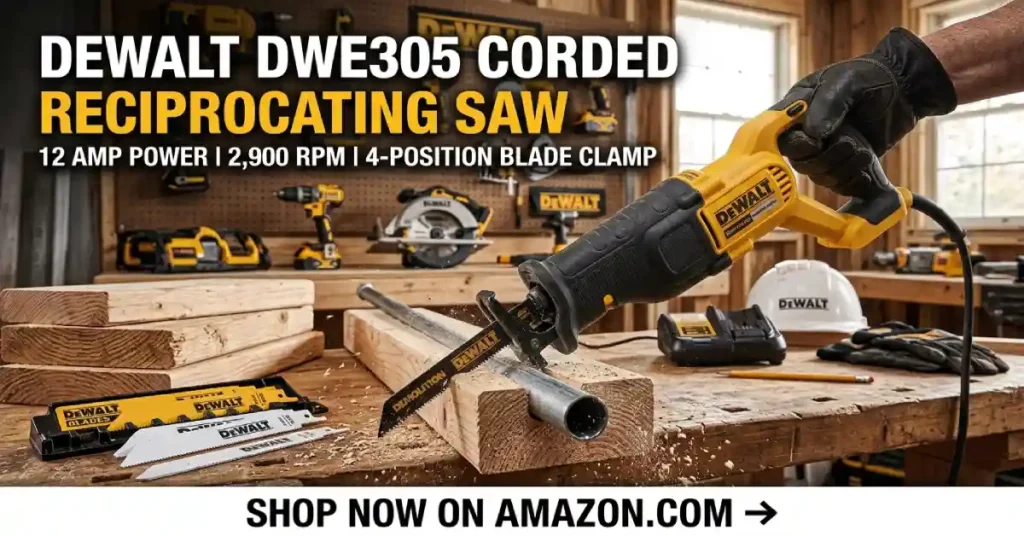
1. DeWalt DWE305 12-Amp Corded Reciprocating Saw – Best Corded Workhorse For Demolition
Key Specifications
- 12 Amp corded motor
- 2,900 strokes per minute, variable speed trigger
- 4-position blade clamp
- 1-1/8 inch stroke length
Features And Performance Highlights
The DWE305 is built around a straightforward idea: give contractors a powerful, dependable saw that never needs a battery. The 12-amp motor pushes through lumber packed with metal nails, thick framing, and old plaster without hesitation. The 4-position blade clamp lets you rotate the blade for flush cuts and awkward angles, and the pivoting shoe keeps the saw stable against uneven surfaces, which is a real advantage during demolition work where you cannot always approach a cut head-on.
Ideal Use Case
This saw is built for job-site contractors and serious DIYers who want a durable, high-power corded saw for demolition, framing, and heavy cutting without worrying about battery runtime. If you are tearing out a kitchen, cutting through old growth wood, or working in a shop with outlets nearby, this is the saw to reach for first.
Pros
- Powerful 12-amp motor with variable speed and a 4-position blade clamp for versatile cutting angles.
- Proven durability and simple internal design make it easy to maintain and a solid long-term investment.
Cons
- The corded design limits mobility and requires extension cords on larger job sites, which can slow you down outdoors or on upper floors.
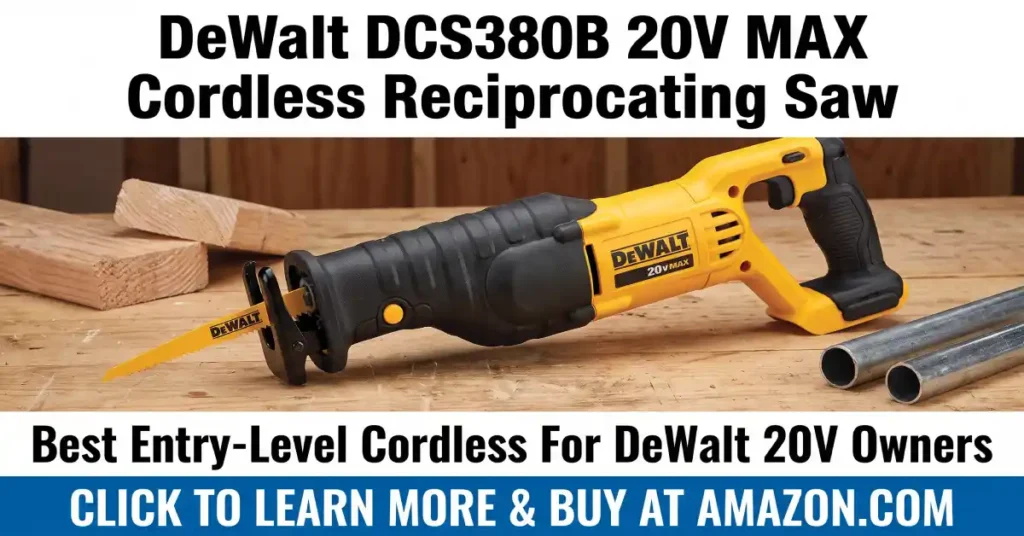
2. DeWalt DCS380B 20V MAX Cordless Reciprocating Saw – Best Entry-Level Cordless For DeWalt 20V Owners
Key Specifications
- 20V MAX cordless brushed motor
- Tool only, battery and charger sold separately
- Variable speed trigger
- 1-1/8 inch stroke length
Features And Performance Highlights
The DCS380B is the affordable entry point into cordless cutting for anyone already invested in the DeWalt 20V MAX battery platform. It skips the premium brushless motor to keep the tool-only price low, but it still delivers enough power for general demolition, remodeling, and yard cleanup. It is also noticeably compact and light for a full-size cordless reciprocating saw, which makes overhead cuts less tiring. An onboard LED light helps illuminate dark corners and crawl spaces, and the ergonomic handle keeps the grip comfortable through long sessions. It runs on the same DeWalt 20V Lithium Ion batteries you likely already use in a cordless drill.
Ideal Use Case
This saw fits homeowners and contractors who already own DeWalt 20V MAX batteries and want an affordable, entry-level cordless saw for general demolition and pruning. If you already have batteries from a drill or impact driver, buying the tool-only version here is one of the cheapest ways to add a reciprocating saw to your kit.
Pros
- Low tool-only cost and full compatibility with the huge DeWalt 20V MAX battery ecosystem.
- Compact and lightweight for a full-size cordless reciprocating saw, which makes it easier to control overhead.
Cons
- The brushed motor is less efficient and gives shorter runtime per charge than the newer brushless XR models on this list.
3. DeWalt DCS386B 20V MAX XR Brushless Cordless Reciprocating Saw – Best Pro-Grade Cordless All-Rounder
Key Specifications
- 20V MAX XR brushless motor
- Tool only, battery and charger sold separately
- Variable speed up to roughly 3,000 SPM
- Tool-free blade clamp
Features And Performance Highlights
The DCS386B upgrades to a brushless motor, which translates into faster cutting, less heat buildup, and noticeably longer runtime per battery charge compared to the brushed DCS380B. Its quick-change accessory system uses a tool-less blade change lever, so you flip the lever, pull the blade, and insert a new one without reaching for a wrench, which matters when you are switching between wood and metal blades throughout the day.
A pivoting shoe and orbital action setting add extra control on tougher cuts, and a built-in LED work light keeps the cut line visible in dim spaces. This model strikes a balance between price and capability that fits most professional and serious DIY use cases.
Ideal Use Case
This is the saw for pros and advanced DIYers who want faster cutting, longer runtime, and more durability than the brushed DCS380 without stepping all the way up to the highest-power XR model. It is a strong daily driver for remodelers and general contractors.
Pros
- The brushless motor delivers faster cutting and longer runtime per battery charge.
- The variable speed trigger and tool-free blade clamp make it efficient for switching between mixed materials.
Cons
- It carries a higher tool-only price than the brushed DCS380, which can be a barrier for casual users who only need a saw occasionally.
4. DeWalt DCS369B ATOMIC 20V MAX One-Handed Cordless Reciprocating Saw – Best Compact One-Handed Saw
Key Specifications
- 20V MAX ATOMIC brushless one-handed design
- Tool only, battery and charger sold separately
- Very low weight, around 3.13 pounds tool only
Features And Performance Highlights
The DCS369B is built for a completely different scenario than the other saws on this list. Instead of maximum power, it prioritizes size and weight, so you can hold it in one hand while your other hand holds a pipe steady, positions a wire, or braces a ladder in tighter spaces where a full-size saw simply will not fit. The brushless motor still gives it respectable cutting speed and runtime given how compact it is, and it pairs well with a compact PowerStack battery for fast charging between calls. It also fits easily into a small carrying bag alongside spare blades.
Ideal Use Case
This saw is built for electricians, plumbers, and remodelers who need a lightweight, one-handed saw for tight spaces, overhead cuts, and quick trim work. It is the saw you keep in the truck for the smaller cuts that do not justify pulling out a full-size saw. For a closer look at real-world performance, specs, and pricing, read our full DeWalt DCS369B ATOMIC review.
Pros
- Very compact and lightweight, which makes it easy to use one-handed in tight spaces and overhead.
- The brushless motor gives strong cutting speed and runtime for its size class.
Cons
- The smaller stroke length and compact design mean it is less ideal for heavy demolition compared with full-size saws.
5. DeWalt DCS367B 20V MAX XR Brushless Cordless Reciprocating Saw – Best High-Power XR For Heavy Demolition And Metal
Key Specifications
- 20V MAX XR high-power brushless motor
- Tool only, battery and charger sold separately
- Long stroke length and high SPM
Features And Performance Highlights
The DCS388B is the most powerful cordless saw on this list. It pairs a high-output brushless motor with a longer stroke length, which lets it chew through thick wood, stainless steel pipe, and other metal faster than the standard DCS386B. Variable speed control and a stable pivoting shoe design give you the precision to slow down for metal cutting and speed up for aggressive demolition, while added vibration control keeps the saw manageable during long, heavy cuts.
Ideal Use Case
This saw is built for contractors and serious users who want the fastest cutting DeWalt 20V reciprocating saw for heavy demolition, metal cutting, and thick wood. If your work regularly involves cutting through studs packed with nails, thick pipe, or dense lumber, this is the model that will save you the most time.
Pros
- The high-power brushless motor and long stroke length deliver aggressive cutting in both wood and metal.
- Strong control features and variable speed allow precise, fast cuts even on demanding jobs.
Cons
- It carries a premium price and pulls more from the battery than lighter-duty models, which makes it less ideal for casual or light tasks.
How To Choose The Right DeWalt Reciprocating Saw For Your Work
Match Saw Type To Job Type
If most of your work is demolition and framing, the corded DWE305 or the high-power XR DCS388B will get through material the fastest. For general remodeling and pruning, the DCS380B or DCS386B cover typical needs without overspending. If you spend your day in tight spaces, overhead, or working around plumbing and electrical, the compact DCS369B one-handed saw is the better fit.
Battery Platform And Ecosystem Value
If you already own DeWalt 20V MAX tools, buying a tool-only reciprocating saw is almost always the cheaper path since you skip paying for another battery and charger. This is one of the biggest reasons contractors stick with one brand’s ecosystem over time. DeWalt’s 20-Volt MAX Li-Ion lineup spans standard PowerPack battery packs for everyday use up through compact, fast-charging PowerStack battery options for anyone who wants less downtime between charges. Older models like the 20V Max DCS382 still show up in secondhand tool bags and use the same battery platform, so an upgrade to a newer saw does not mean starting your battery collection over.
For users who regularly max out a 20V MAX saw on thick material, DeWalt’s FlexVolt Advantage lineup, built around DeWalt FlexVolt 60V Max batteries, delivers substantially more power for the heaviest demolition and metal-cutting jobs. It is a bigger investment, so most homeowners and remodelers are better served staying on the 20V MAX platform covered in this guide. For a deeper breakdown of how to weigh these models against each other based on your existing tools and budget, see our full guide on which DeWalt reciprocating saw should I buy.
Blade Types And Applications
The saw is only half the equation. Wood blades, metal-cutting blades, demolition blades, and pruning blades are all shaped and toothed differently for a reason, and using the wrong one slows you down and wears out faster. Most quick change clamps also accept blade insert directions from either the top or bottom, which is worth checking against your manual so you seat the blade correctly before you pull the trigger. If pruning overgrown brush or thick branches is part of your routine, our guide to reciprocating saw pruning blades explains which blades hold up best on green wood and branches. For general accuracy across materials, our tips on how to cut straight with a reciprocating saw apply no matter which model you choose.
Safety Features To Look For
Look for a variable speed trigger, a stable adjustable shoe, and, on higher-end models, an electric brake that stops the blade quickly once you release the trigger. Combine these features with proper PPE, including eye protection and gloves, every time you cut.
Noise, Dust, And Job-Site Considerations
Reciprocating saws are loud, and demolition work kicks up dust. If you are working indoors or near neighbors, plan cutting sessions during reasonable hours and use a shop vacuum or dust barrier when tearing into walls. Once you have your saw dialed in, it also helps to know how to swap blades quickly and safely. Our guides on how to change a blade on a DeWalt reciprocating saw and how to remove a broken blade from a reciprocating saw walk through both the routine and the frustrating parts of blade maintenance.
Using And Maintaining A DeWalt Reciprocating Saw
Basic Setup: Blade Selection, Shoe Adjustment, And Speed Control
Start every job by matching the blade to the material and adjusting the shoe so it sits flush against the workpiece. This keeps the blade stable and reduces vibration, which makes for a straighter, faster cut and less strain on your hands over a long day.
Blade Changes And Broken Blade Removal
Most modern DeWalt reciprocating saws use a tool-free blade clamp, which makes swapping blades between wood and metal jobs quick. Occasionally a blade snaps mid-cut and leaves a piece stuck in the clamp. Rather than forcing it out, follow a proper removal process to avoid damaging the clamp mechanism. Our step-by-step guides on changing a blade on a DeWalt reciprocating saw and removing a broken blade from a reciprocating saw cover both situations in detail.
Extending Battery Life And Runtime For Cordless Models
Use the correct blade for the material, avoid forcing the saw through a cut, and let the tool’s speed do the work instead of pushing harder. Overworking the motor drains the battery faster and generates unnecessary heat, which shortens battery life over time.
When To Upgrade From A Smaller Saw To A Larger One
If you find yourself constantly pushing an entry-level cordless saw or a compact one-handed model past its comfort zone on thick material, that is usually a sign it is time to add a high-power XR model or a corded saw to your kit rather than replacing what you already own.
Frequently Asked Questions About DeWalt Reciprocating Saws
Which DeWalt reciprocating saw is best for demolition?
For heavy demolition, the corded DWE305 or the cordless DCS388B XR are the strongest choices. Both offer high power and longer stroke lengths that cut through nail-embedded lumber and thick material quickly.
Is a corded or cordless DeWalt reciprocating saw better for job-site work?
It depends on the job. Corded saws give unlimited runtime and consistent power, which suits long demolition sessions near an outlet. Cordless saws give you freedom to move around the site without a cord, which matters more for varied tasks throughout the day.
How long does a DeWalt 20V MAX battery last in a reciprocating saw?
Runtime depends on the battery’s amp-hour rating, the blade used, and the material being cut. A brushless model like the DCS386B or DCS388B will generally get more cuts per charge than a brushed model like the DCS380B, since less energy is lost to motor friction.
Are DeWalt one-handed reciprocating saws powerful enough for pros?
Yes, for the tasks they are designed for. Models like the DCS369B ATOMIC handle trim cuts, pipe cutting, and tight-space work well, but they are not meant to replace a full-size saw for heavy demolition or thick material.
How often should I change the blade on my DeWalt reciprocating saw?
Change the blade as soon as you notice slower cutting, excessive vibration, or visible dull or missing teeth. Cutting with a dull blade forces you to push harder, which increases the risk of binding and kickback.
Can a DeWalt reciprocating saw cut metal and wood with the same blade?
Generally no. Wood blades and metal blades have different tooth counts and geometry. Using a dedicated metal blade for metal cuts and a wood or demolition blade for wood gives cleaner results and extends the life of both the blade and the saw.
Final Verdict: The Best DeWalt Reciprocating Saw For Your Situation
If you are searching for the single best DeWalt 20V reciprocating saw, the DeWalt DCS386B 20V MAX XR Brushless Cordless Reciprocating Saw is the best all-round pick for most pros and serious DIYers. It balances power, runtime, and price in a way that fits the widest range of real-world jobs.
If you need maximum power with no battery concerns, the DWE305 corded saw remains the best choice for heavy demolition. If you are just building your DeWalt 20V MAX collection and want an affordable entry point, the DCS380B gets the job done without a high upfront cost. For pros who want the fastest, most capable cordless option, the DCS388B XR handles the toughest demolition and metal cutting. And for tight spaces, overhead work, plumbing, and electrical jobs, the compact DCS369B ATOMIC is hard to beat.
Whichever model fits your work, base the final decision on your job type, the battery platform you already own, and your budget. Prices, ratings, and availability on Amazon change often, so check the current listing before you buy to make sure you are getting the best deal on the model that fits your needs.
Table of Contents