

A band saw is a power tool that uses a continuous looped blade to make smooth, straight, and curved cuts in wood, metal, plastic, and other materials. The thin blade runs on two wheels inside the saw’s frame, which keeps it moving in a constant, controlled motion.
Inside the machine, an electric motor turns the drive wheel. The drive wheel pulls the blade, while the second wheel keeps it tight and tracking correctly. As you push your workpiece across the table and into the blade, the teeth remove material in a narrow kerf, resulting in accurate cuts with minimal waste.
Because the blade is long, thin, and always moving in the same direction, a band saw can cut tight curves, irregular shapes, and thick stock that would be difficult or unsafe on many other saws. With the right blade and setup, it can also resaw boards into thinner pieces or veneers, slice small parts safely, and handle both rough dimensioning and fine work in the same machine.
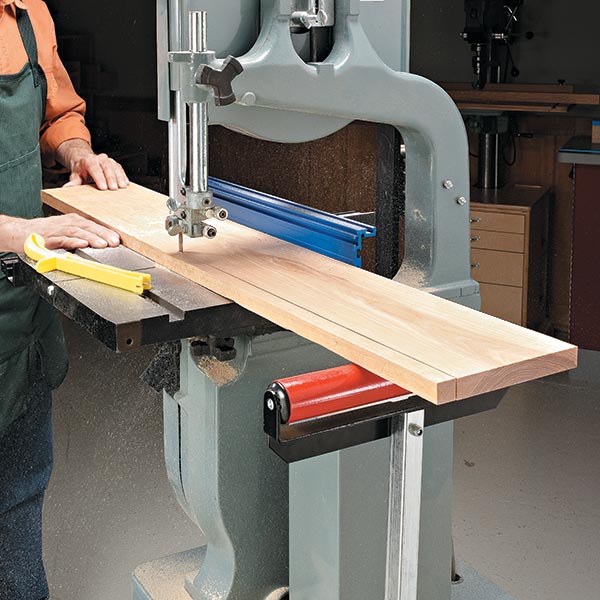
Credit: www.woodsmith.com
How Does a Band Saw Work?
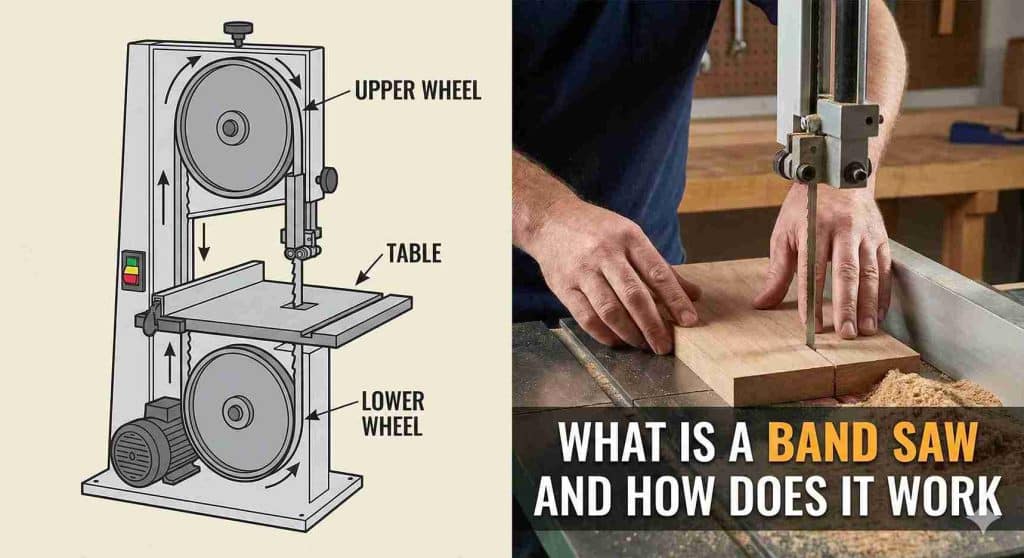
The cutting mechanics of a band saw are relatively simple but effective. An electric motor powers both the upper wheel (drive wheel) and the lower wheel (driven wheel).
-
Blade Movement: The drive wheel pulls the continuous looped blade down through the table.
-
Tension: The wheels are adjustable to keep the blade under high tension, ensuring it runs straight.
-
Cutting Action: The user pushes material across the table into the blade. As the material passes through the blade, the teeth slice away wood in a continuous motion.
This mechanism allows the band saw to handle thick stock (resawing) that other saws, like table saws, cannot handle.
What is the Purpose of a Band Saw?
The primary purpose of a band saw is versatility. It allows professional craftsmen, such as carpenters, cabinet makers, and metalworkers, to execute cuts that are either unsafe or impossible on other machines.
Its ability to make both curved cuts and straight rip cuts makes it unique. The blade moves in a single direction (downward) and creates clean edges without the splintering often seen with reciprocating saws.
What are the Top 5 Uses for a Band Saw?
A band saw is a versatile tool that can be used for many different purposes. The top five uses of a band saw are as follows:
01. Cutting Curves: It is the best tool for cutting irregular shapes, circles, and cabriole legs for furniture.
02. Resawing: Slicing a thick board into thinner veneers or book-matched panels. This is a “superpower” of the band saw.
03. Ripping Lumber: Cutting rough lumber to width. It is safer than a table saw because there is no risk of kickback.
04. Tenoning: Cutting the cheeks of tenons for joinery work.
05. Metal Cutting: With a special blade and slower speeds, it can cut steel plates, pipes, and angled slots.
Types of Band Saws
Woodworking Band Saws
These are the standard upright saws found in most shops. They come in floor-standing models (usually 14-inch or larger wheels) for heavy work, and benchtop models (9 to 10-inch wheels) for lighter hobbyist work.
Portable Band Saws
A portable band saw is a handheld version used primarily by plumbers, electricians, and metalworkers. It allows the user to bring the tool to the workpiece, making it ideal for cutting pipes, rebar, or unistrut on a job site where a stationary saw won’t fit.
Comparisons: Band Saw vs. Other Saws
Band Saw vs. Circular Saw
While both are essential, they serve different roles. A circular saw is a handheld tool designed primarily for straight cuts, crosscuts, and breaking down sheet goods like plywood. It is built for speed and portability. A band saw is generally stationary and excels at curved cuts and cutting very thick stock that a circular saw blade cannot penetrate.
Band Saw vs. Scroll Saw
The band saw is a heavy-duty machine used for cutting thick wood (up to 12 inches or more) and rough curves. The scroll saw uses a tiny, hair-thin reciprocating blade. It is designed for extremely intricate, puzzle-like cuts in very thin wood. If you need to cut the inside of a letter (like the hole in an “O”) without cutting through the outside, you need a scroll saw, not a band saw.
How to Use a Band Saw for Beginners
If you are new to this tool, safety and setup are your priorities.
Safety First: Always wear eye protection. Never wear loose clothing or gloves that could get caught in the moving blade.
Read the Manual: Understand the specific tension and tracking knobs on your machine.
Check Tension and Tracking: Before turning it on, ensure the blade is tight and runs in the center of the wheels.
Set the Blade Guide: Lower the blade guard so it is about 1/4 inch above your workpiece. This protects your fingers and supports the blade.
Hand Position: Keep hands clear of the cut line. Push the wood firmly against the table (and fence, if ripping).
Let the Saw Work: Don’t force the wood. Push gently and let the teeth clear the material.
Bandsaw Basics – WOOD magazine
What is a Band Saw Used for
A band saw is a versatile and powerful tool used for cutting irregular shapes in wood, plastic, or metal. It can make curved cuts, straight crosscuts, and rip cuts with ease. Band saws are also great for resawing lumber into thinner boards, as well as making veneer out of logs.
With the right blade and adjustment settings, they can even be used to cut glass or tile!
What is a Portable Band Saw Used for
A portable band saw is an incredibly versatile tool that can be used for many different applications. It’s great for cutting through metal, wood, plastic, and other materials in a variety of shapes and sizes with precision and accuracy. The portability makes it ideal for jobsite use or maneuvering around tight spaces where other larger saws cannot fit.
Additionally, the blade can be easily adjusted to control the depth of cut as well as make angled cuts depending on the task at hand.
What is a Band Saw Used for in Woodworking
A band saw is a power tool used in woodworking for making curved cuts and intricate shapes. It has a continuous loop of a metal blade with teeth on one side that spins around two or more wheels to cut through the material. This makes it ideal for cutting complex curves and contours, as well as resawing lumber into thinner pieces.
Additionally, band saws can be used to make dados, rabbets, lap joints, and tenons.
Band Saw Vs Scroll Saw
When it comes to woodworking, two common tools are the band saw and the scroll saw. The band saw is a powerful machine that uses a continuous blade looped over two or more wheels to make long, straight cuts in thick material like logs or boards. This type of saw is great for making rough shapes and cutting large pieces quickly.
On the other hand, the scroll saw uses a thin reciprocating blade with fine teeth that move up and down through small openings in the material being cut, allowing users to create intricate curved patterns and smooth edges on thinner woods like plywood sheets or veneers. Both are important tools for any woodworker’s toolbox; however, depending on your project requirements, you should select one appropriate for your needs, as they do have different functions.
Frequently Asked Questions (FAQ)
1. Is a band saw better than a table saw?
It depends on the task. A band saw is better for cutting curves, irregular shapes, and resawing thick lumber because it has a thinner blade and no kickback risk. However, a table saw is superior for making perfectly straight, repeatable rip cuts and crosscuts on sheet goods and boards. Most woodworking shops eventually need both.
2. What is the difference between a 2-wheel and a 3-wheel band saw?
A 2-wheel band saw is the standard design used for most woodworking; it offers a simple, reliable path for the blade and causes less metal fatigue. A 3-wheel band saw is typically a compact benchtop model designed to offer a larger throat depth (width of cut) in a smaller machine footprint, but the extra bending of the blade can lead to more frequent blade breakage.
3. Can a band saw cut metal?
Yes, but you cannot use a standard wood blade. Cutting metal requires a bi-metal blade with a high tooth count (TPI) and, crucially, a slower blade speed. Many dedicated metal-cutting band saws have gearboxes to lower the speed, as running a wood band saw at high speed on steel will instantly dull the blade and ruin the temper.
4. How thick of wood can a band saw cut?
This is determined by the “resaw capacity,” which is the vertical distance between the table and the upper blade guide. A standard 14-inch band saw can usually cut wood about 6 inches thick. However, by adding a “riser block” or using a larger industrial saw, you can cut wood 12 inches thick or more.
5. Why does my band saw blade wander to the side?
Blade “drift” or wandering is usually caused by a dull blade, insufficient blade tension, or improper tracking adjustments. It can also happen if you are forcing the wood through the saw too fast. Ensuring your blade is sharp and the tension is set correctly for the blade’s width is the best way to fix this.
Conclusion
A band saw is a highly versatile tool that can be used for a variety of tasks, from cutting wood to metalworking. They are easy to use and operate, making them great for beginners or professionals alike. Although there are different types of bandsaws available, all have the same basic design and function in mind – to cut through materials with more accuracy than other saws.
With regular maintenance and proper usage, your band saw should last you many years of reliable service.
Table of Contents