

By the Editorial Team at SawTheory.com | Updated May 2026
A dull chainsaw chain is one of those problems that gets worse the longer you ignore it. The saw works harder, the engine runs hotter, cuts wander off line, and the risk of kickback climbs. Knowing how to sharpen a chainsaw properly — with the right file, the right angle, and the right technique — is the single most valuable maintenance skill any chainsaw owner can develop.
This guide covers everything: which round file matches your chain’s pitch, how to hold the file at the correct angle, when to adjust your depth gauges, and when the chain is too far gone to bother with. If you follow these steps consistently, your chain will cut cleaner, your engine will last longer, and your saw will be noticeably safer to operate.
Quick Answer Summary
- File size matches chain pitch — not gauge, not bar length. A 3/8″ LP (low-profile) chain uses a 5/32″ file. A standard 3/8″ chain uses a 7/32″ file. A .325″ chain uses a 3/16″ file. A .404″ chain uses a 7/32″ file.
- Filing angle is typically 25–35 degrees — 30 degrees is the standard for most general-purpose chains. Check your chain’s packaging or owner’s manual for the exact spec.
- File 1/5 above the cutter’s top plate — the round file should sit so that approximately one-fifth of its diameter sits above the top plate of the tooth during filing.
- Check depth gauges every 3–4 sharpenings — the standard clearance is 0.025 inches (0.635mm) below the cutter top for most general-purpose chains.
- A chain that pulls in one direction, vibrates excessively, or produces dust instead of chips needs sharpening — chips mean sharp; dust means dull.
- Replace the chain when the cutter length drops below 4mm, when teeth are cracked or chipped, or when the chain has been stretched beyond spec.
Chainsaw Pitch and Corresponding File Sizes
This is the reference table you need before buying files. Using the wrong file diameter distorts the cutter geometry and can make a chain cut worse than before sharpening.
| Chain Pitch | Common Name | Round File Size (Imperial) | Round File Size (Metric) | Typical Saw Class |
|---|---|---|---|---|
| 1/4″ | Micro / Mini | 4.0 mm | 4.0 mm | Compact/hobby saws |
| .325″ | Three-Twenty-Five | 3/16″ | 4.8 mm | Mid-size, limbing, light production |
| 3/8″ Low Profile | 3/8″ LP / Picco / Micro | 5/32″ | 4.0 mm | Homeowner / light-duty saws |
| 3/8″ Standard | Three-Eighths | 7/32″ | 5.5 mm | Professional mid-size to large saws |
| .404″ | Four-Oh-Four | 7/32″ | 5.5 mm | Commercial / logging saws |
How to identify your chain’s pitch: Measure the distance between any three consecutive rivets (the round pins connecting the chain links) and divide that measurement by two. The result is the pitch. You can also find it stamped on the drive links or printed on the chain’s packaging.
Note on STIHL 3/8″ chains: STIHL’s 3/8″ standard chains use a slightly smaller cutter profile than other manufacturers. STIHL recommends a 13/64″ (5.2mm) file for their standard 3/8″ chains rather than the industry-standard 7/32″ (5.5mm). When filing a STIHL chain, confirm the specification in your owner’s manual rather than relying on the general chart above.
Tools You Need to Sharpen a Chainsaw
Collect all of these before you start. Improvising with the wrong file size or skipping the depth gauge tool produces inconsistent results.
- Round file — sized to your chain’s pitch per the table above. Oregon, STIHL, and Husqvarna all produce quality files. Cheap, no-brand files dull quickly and damage cutter geometry.
- File guide / file holder — a simple plastic or metal guide that snaps onto the chain and holds the file at the correct angle and depth automatically. Essential for beginners; useful for experienced operators on unfamiliar chains.
- Flat file (mill bastard file) — used to adjust depth gauges (rakers). A 6-inch flat file works for most chains.
- Depth gauge tool — a stamped metal template that sits over the chain. If the raker protrudes through the slot, it needs filing. Available from Oregon, STIHL, and Husqvarna for under $10.
- Bar vise or bench vise — clamps the bar securely so the chain cannot rotate during filing.
- Heavy-duty work gloves — cut-resistant gloves, not standard leather. The teeth are sharp enough to cut skin during handling.
- Marker or paint pen — for marking the starting cutter so you know when you have filed one complete revolution.
- Wire brush or compressed air — for cleaning sawdust and resin from the chain before you begin.
- Safety glasses — metal filing produces fine particles.
Step 1: Safety First — Prepare the Saw Correctly
Before touching a file to any cutter, the saw needs to be secure and the chain needs to be immobile.
Disengage the spark plug wire. On a gas saw, pull the spark plug boot off the plug before doing any chain work. On a battery chainsaw, remove the battery pack. A saw that cannot start is a saw that cannot injure you if it is accidentally bumped.
Engage the chain brake. Push the front hand guard forward until it locks. The chain brake stops the chain from rotating. It does not, however, lock the chain completely — it provides resistance, not a rigid hold. The vise handles the rigid hold.
Clamp the bar in a vise. Position the bar between the vise jaws near the saw body — not at the tip — and tighten firmly. The bar should not flex or shift when you apply lateral pressure with the file. If you are working in the field without a vise, brace the saw firmly against a stable surface and press the bar against a fixed object. A bar that shifts mid-stroke produces uneven cutter angles.
Clean the chain. Use a wire brush to remove sawdust, pitch buildup, and debris from the cutters before you start filing. Filing over a dirty chain shortens the life of your file and produces inconsistent results.
Inspect the chain. Look for cracked links, bent drive links, or teeth that are missing a corner. If you find any of these, stop here and go to the section on when to replace the chain before proceeding.
Step 2: Find the Starting Point and Understand the Cutter Geometry
Every cutter on a chainsaw chain is identical — or should be by the time you are done sharpening. Finding a logical starting point and marking it prevents you from filing the same cutter twice or missing one entirely.
Identifying the Starting Cutter
Look for the master link — the link with a clip rather than a rivet, or a slightly different appearance from the other links. That is a common starting point. Alternatively, choose the cutter that looks the most worn or the one directly above the vise jaw. Mark it clearly on the top plate with a permanent marker.
Understanding Cutter Geometry
Each cutter has two primary surfaces you are filing:
The top plate — the flat surface on top of the cutter, angled forward. This is the primary cutting surface. The angle it makes with the chain’s direction of travel (measured in the horizontal plane) is the top plate filing angle — typically 25 to 35 degrees, with 30 degrees being standard for most general-purpose chains.
The side plate — the vertical face of the cutter that drops down toward the bar. This surface creates the depth of cut. On most chains, the side plate runs perpendicular to the bar, though it can be slightly angled depending on the chain design.
Both surfaces are sharpened simultaneously with a single forward stroke of the round file — the round file profile contacts both faces at once when held at the correct angle.
Right-Hand vs. Left-Hand Cutters
Chainsaw cutters alternate left-hand and right-hand configurations around the chain. You will file all the cutters pointing in one direction before switching sides. This is the most common beginner error — alternating left and right with every cutter creates angle inconsistencies and uneven cutting.
Decide which side you will start on and file every cutter on that side through one complete rotation of the chain. Then release and re-clamp the bar, position yourself on the other side, and complete all cutters in the opposite direction.
Step 3: File the Cutters at the Correct Angle
This is the core of the sharpening process. The technique here directly determines how well the chain cuts.
Setting Up the File Guide
If you are using a file guide, clip it onto the chain per the manufacturer’s instructions. The guide references the top of the depth gauge on either side of the cutter to set the correct file height — ensuring the file contacts the cutter at the proper depth. Most guides are adjustable for different chain pitches.
If you are filing freehand, the rule is: the file should sit so that approximately one-fifth (20%) of its diameter is above the top plate of the cutter. For a 7/32″ (5.5mm) file, that is about 1.1mm of file sitting above the top plate. This keeps the file contacting the full curved profile of the cutter rather than riding too high or digging into the side plate.
The Filing Motion
Hold the file handle in your dominant hand with your index finger extended along the file for guidance. Your off hand grips the file tip or rests a finger on the chain for stability.
Position the file at the correct horizontal angle — typically 30 degrees relative to the perpendicular of the bar. If your file guide has angle markings, line them up. If filing freehand, use the angle marks engraved on the top plate of the cutter itself as a visual reference — they show you exactly where the cutting edge should be when correctly filed.
Apply steady, moderate pressure on the forward stroke only. Pull the file back without pressure — dragging under pressure on the back stroke rounds the file’s cutting teeth and dulls it prematurely.
Use three to five consistent strokes per cutter — then move to the next cutter on the same side. Resist the instinct to file one cutter until it feels perfect before moving on. File every cutter the same number of strokes first, then assess uniformity. This produces a more even chain than grinding one cutter to satisfaction while leaving others untouched.
A correctly filed cutter produces a bright, clean, flat shine on the top plate. If the top plate looks uneven or still shows a grey, dull edge in spots, add one or two more strokes. If you can see a thin sliver of bright metal reflecting light consistently across the full cutter edge, that cutter is sharp.
Maintaining a consistent angle across all cutters
This is where most manual sharpening fails. Every cutter must be filed at the same angle for the chain to cut straight. A chain where some cutters are filed at 28 degrees, and others at 33 degrees, will pull to one side and produce rough, wandering cuts.
If you are new to manual sharpening, use a file guide for at least the first several sessions until the correct angle becomes muscle memory. A logging operation in the Pacific Northwest found that chains sharpened with quality file guides lasted 30% longer and required less frequent resharpening than those sharpened freehand — the angle consistency was the determining factor.
After Completing One Side
Once all cutters on the first side are filed, rotate the chain by hand (gloves on, chain brake engaged) to expose the opposite-direction cutters. Re-clamp the bar, switch your body position to the other side of the saw, and repeat the process. The filing angle mirrors itself — if you filed at 30 degrees from the right side, you file at 30 degrees from the left side for the opposite cutters.
Step 4: Adjust the Depth Gauges (Rakers)
Most operators stop at Step 3. That is a mistake.
The depth gauges — often called rakers — are the small, rounded projections that sit just in front of each cutter. They control how deep each cutter bites into the wood on each pass. As you file the cutters, they get shorter. As the cutters get shorter, the depth gauges proportionally become too tall — they start limiting the bite too aggressively, causing slow cutting even on a freshly sharpened chain.
Check your depth gauges after every three to four sharpenings. Most professional chains perform best at the standard 0.025-inch setting.
The Correct Depth Gauge Clearance
A depth gauge setting of 0.025 inches (0.635mm) is a good starting point for most chains. For hardwoods, a slightly higher setting of 0.030 inches (0.762mm) can prevent the chain from grabbing too much wood. For softwoods, a slightly lower setting of 0.020 inches (0.508mm) can increase cutting speed.
Lowering the rakers too much can cause the chain to bite too aggressively, increasing the risk of kickback and putting undue strain on the saw’s engine. Err on the high side when uncertain — a slightly conservative raker height is safer than an excessively low one.
How to File Depth Gauges
Place the depth gauge filing tool flat across the chain so its slot sits directly over the raker you are checking. If the rake protrudes above the top surface of the tool, it is too tall and needs filing. If it sits below the tool surface, it is at or below the correct clearance — leave it alone.
Filing the raker should be done until it is flush with the guide’s surface, restoring the correct clearance of around 0.025 inches (0.65mm) for standard chains.
Use the flat file in horizontal strokes across the top of the raker, keeping the file perfectly level. One or two strokes are typically all that is needed. Remove the gauge tool and check again — repeat until the raker no longer protrudes through the slot.
After filing each raker down to height, use the flat file at a slight angle to round the leading edge of the raker. This is called rounding the rake profile, and it prevents the rake from catching dirt and causing vibration. Most depth gauge tools have a secondary, rounded slot specifically for this step.
Work through every raker on the chain the same way you worked through every cutter — one complete rotation without skipping.
Step 5: Inspect the Chain and Test Cut
Before reinstalling the chain and running the saw, do a final inspection.
Check cutter uniformity. Sight down the chain from above. Every cutter should be the same length. If one or two cutters are visibly shorter than the others, they were filed more aggressively than the rest and will cause the chain to cut unevenly. File the longer cutters down to match.
Check file marks. Every cutter should show bright filing marks across the full top plate. If any cutter still shows grey, dull steel in the corner or along the edge, it was not filed to the full cutting edge. Add one or two strokes.
Reinstall the chain and tension it correctly. Chain tension is a separate but critical topic — the correct tension allows the drive links to sit in the bar groove while the chain can be pulled around by hand with light resistance. A chain that sags more than 1/4 inch below the bar’s underside is too loose. A chain that cannot be pulled by hand is too tight.
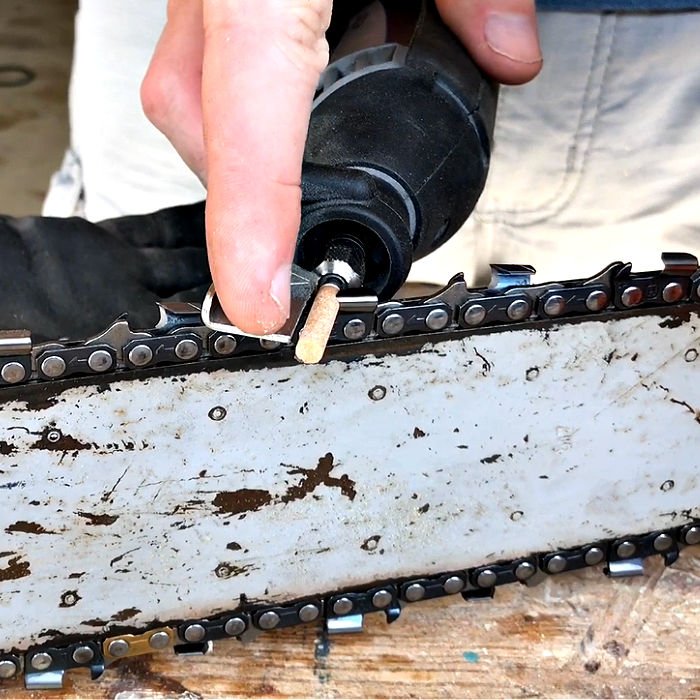
Test cut on scrap wood. A correctly sharpened chain produces consistent chips — not dust — and cuts without requiring excessive downward pressure. If the saw pulls to one side, the cutters on that side are sharper or filed at a more aggressive angle than the opposite side. If the saw bogs down under light pressure, the depth gauges may still be too high or the chain may need one more pass with the file.
Credit: www.abbottsathome.com
Knowing When to Stop Sharpening and Replace the Chain
Sharpening extends chain life, but no chain lasts forever. Here are the conditions that signal it is time to retire the chain rather than file it again.
Cutter length below 4mm. Most new cutters measure 6.5–8mm from the back of the cutter to the cutting edge. When the filing has reduced the cutter to below 4mm, there is not enough material left to hold a durable edge. The cutter will dull within a few cuts.
Cracked, chipped, or missing cutter corners. Filing cannot restore structural integrity. A cutter that has hit rock, rebar, wire, or frozen ground can chip or crack. These cutters create vibration and cut unevenly, regardless of sharpening.
Stretched or elongated drive links. A chain that has been run too loose, run without adequate lubrication, or run to breaking point will stretch. Stretched chains cannot maintain proper tension and wear the bar groove and sprocket rapidly. Check stretch by pulling the chain at the bar’s underside midpoint — more than 1/4 inch of droop on a properly tensioned chain indicates stretch.
Kinked or bent drive links. If a link does not move freely around the bar tip, it will bind, create vibration, and cause the bar to wear unevenly. Links bent by impact cannot be straightened reliably.
Worn tie straps. The tie straps connecting the cutters and drive links should have straight, flat sides. Rounded or mushroomed tie strap edges indicate severe wear — the chain is at the end of its life.
A new chain from a quality manufacturer (Oregon, STIHL, Husqvarna) costs $15–$50, depending on the pitch and bar length. Running a worn-out chain to save that cost creates bar wear, sprocket wear, and engine strain that costs far more in the long run.
How Often Should You Sharpen a Chainsaw Chain?
The answer depends on how you use it, not how much time has passed.
A chain cutting clean, dry softwood stays sharp much longer than a chain working through dirty logs, sandy soil-covered wood, or frozen timber. As a general baseline:
- Occasional homeowner use (seasonal firewood, storm cleanup): Sharpen every 2–3 tanks of fuel, or any time you notice the saw requiring noticeably more downward pressure than usual.
- Regular property maintenance use: Sharpen every 1–2 tanks of fuel. File guides and a consistent technique make this a 10–15-minute task with practice.
- Professional daily use: Most professional operators touch up the chain at lunch and again at the end of the day during heavy production. High-volume operators often carry pre-sharpened spare chains and swap rather than file in the field.
The fastest indicator is cut quality: if the saw is producing fine dust rather than consistent chips at the kerf, the chain needs sharpening now, regardless of when you last filed it.
Why a Sharp Chain Matters Beyond Just Cutting Speed
A dull chain does not just cut slowly — it creates a cascade of problems through the entire saw.
Increased kickback risk. A dull chain is more likely to catch or bind in the wood rather than cut cleanly through it. Binding in the bar tip zone is the primary cause of kickback — the sudden, violent upward rotation of the bar that accounts for the majority of serious chainsaw injuries. As regulatory bans on gas engines push more operators toward battery-powered saws, correct sharpening becomes just as critical on electric chains as on gas — the kickback risk does not change with the power source.
Engine wear. On a gas saw, a dull chain forces the engine to work harder for the same cut. Higher sustained load means higher operating temperatures, more frequent carb adjustments, and shortened engine life. On a battery chainsaw, a dull chain draws more current per cut — shortening runtime and stressing the motor’s thermal management.
Bar and sprocket wear. A chain running under excessive tension from a dull cutter’s resistance creates uneven wear patterns on the bar rails and the drive sprocket. Bars cost $30–$80. Sprockets cost $15–$40. Replacing them because the chain was dull is entirely avoidable maintenance spending.
Operator fatigue. Pushing a dull chain through wood requires steady downward pressure that a sharp chain does not need. Over a full day of work, that additional effort — multiplied across hundreds of cuts — produces real physical fatigue. A sharp chain does its own work.
Manual Filing vs. Electric Chainsaw Sharpeners
Manual filing with a round file is the technique covered in this guide because it requires no power source, travels anywhere, costs almost nothing in tools, and produces professional results with practice.
Electric bench sharpeners (Oregon 520-120, STIHL FG 2, and similar) automate the angle and depth setting using a motorized grinding wheel. They are faster on a full chain and more consistent for operators who do not sharpen frequently enough to develop muscle memory. They cost $50–$250, depending on the model.
The trade-off: a grinding wheel removes more material per pass than a hand file. Operators who over-grind with an electric sharpener shorten chain life faster than hand filing. For occasional sharpening, a file and guide is the correct investment. For a professional operation sharpening multiple chains daily, a bench sharpener earns its cost quickly.
Summary: The Sharpening Process at a Glance
- Remove the spark plug wire (gas) or battery pack (electric/battery).
- Engage the chain brake. Clamp the bar in a vise.
- Clean the chain. Inspect for damaged links.
- Mark the starting cutter with a marker.
- Select the correct round file for your chain’s pitch.
- File all cutters on one side — same number of strokes per cutter, same angle throughout.
- Switch sides and file all opposite cutters.
- Check depth gauges with the depth gauge tool every 3–4 sharpening sessions. File rakers flush with the tool surface using a flat file.
- Round the leading edge of each raker.
- Reinstall and tension the chain correctly.
- Test cut on scrap wood. Chips mean sharp. Dust means not done yet.
A chain you sharpened yourself — with the right file, the right angle, and consistent strokes — cuts just as well as one returned from a professional sharpening service. Probably better, because you know exactly what angles were applied.
Sources: Oregon Products sharpening technical documentation; STIHL operator’s manuals and file size specifications; Husqvarna chainsaw maintenance guidelines; Timberline Chainsaw Sharpener sizing guide; NEWBENY Tool file selection guide (April 2025); Chainsaw Skill depth gauge tutorial (December 2025); Engineer Fix chainsaw file guide tutorial (December 2025); Chainsaw Nerds sharpening angle chart with material-specific recommendations (September 2025); Hipa Store round file selection guide (March 2026).
SawTheory.com publishes independent equipment analysis, maintenance guides, and reviews for professional arborists, timber fallers, and serious landowners.
Table of Contents