

The best electric chainsaw depends on the job in front of you, but for most homeowners, the Oregon CS1500 is the strongest all-around corded pick because it pairs an 18-inch bar with a built-in self-sharpening chain and unlimited runtime near an outlet, while a verified 20-inch Battery Chainsaw from a major cordless platform, a two-battery brushless kit, a compact one-handed cordless model, and the Craftsman CMECS600 round out the picks for mobility, complete kits, light pruning, and lightweight homeowner cutting.
There is no single Chainsaw that wins every category, and the right pick changes once you factor in branch and log size, how often you cut, the size of your property, outlet access, the battery system you already own, your physical strength, and whether you need continuous runtime or true cordless freedom.
Among power tools built for yard and property work, few get compared as often as electric chainsaws, lawn mowers, and other Battery & Electric Chainsaws in a landscaper’s shed, and cutting speed, battery life, and chain design all factor into which one is right for your property. This guide compares five main products plus two additional Amazon listings worth checking, covering different jobs rather than five versions of the same saw.
Two lean cordless and battery-powered, one is a complete two-battery kit, one is a compact handheld option, and two are corded electric models from established brands. That mix matters because a saw built for continuous corded cutting near the house is rarely the best choice for storm cleanup across a large property, and a compact cordless saw built for light pruning is not meant to replace a full-size saw processing firewood.
A transparency note before we go further. Of the products referenced in this comparison, only the Oregon CS1500 and the Craftsman CMECS600 returned a verifiable current listing through available manufacturer and retailer sources at the time of writing.
The remaining cordless models are marked “verify current listing” throughout this guide rather than assigned invented specs, ratings, or prices. Amazon rating, review count, stock status, and kit contents should be confirmed directly on the live listing before publication or purchase.
Quick Picks: Best Electric Chainsaws
Quick Picks: Best Electric Chainsaws
Prices and availability change often on Amazon. Confirm current details on each product page before buying.
Comparison Table: Best Electric and Cordless Chainsaws
Whether you search for a cordless chainsaw, a battery-powered chainsaw, or an electric chainsaw for homeowners, these five spec sheets side by side should make the tradeoffs easier to see at a glance.
Best Electric Chainsaws at a Glance
| Model | Power Source | Motor Type | Bar Length | Best For | Strength | Limitation |
|---|---|---|---|---|---|---|
| Oregon CS1500 | Corded, 120V | Standard 15-amp | 18 in | Continuous cutting near an outlet | Self-sharpening chain, unlimited runtime | Cord limits mobility |
| Flagship Brushless Cordless Chainsaw | Cordless | Brushless (verify listing) | Verify listing | Mobile cordless cutting | Brushless motor, complete battery kit | Support and parts availability need verification |
| Two-Battery Cordless Chainsaw | Cordless | Brushless (verify listing) | Verify listing | Longer sessions without a mid-job recharge | Spare battery included | Runtime depends on total watt-hours, not battery count |
| Cordless Handheld Tool-Free Chainsaw | Cordless | Verify listing | Verify listing | Light pruning and small-yard jobs | Compact, one-handed format | Not built for large branches or trees |
| Craftsman CMECS600 | Corded, 12-amp | Brushed | 16 in | Homeowner yard work, overhead cutting | Very lightweight at 6.19 lb, 3-year warranty | Requires an outlet, no listed chain brake |
Pricing, ratings, and availability change often on Amazon. Confirm current details on each product page before buying.
What Is an Electric Chainsaw?
An electric Chainsaw runs on either a power cord plugged into an outlet or a rechargeable battery system, which is why the category splits into corded models and battery-powered chainsaws. Either way, it removes gasoline and two-stroke fuel mixing from the equation entirely, unlike petrol saws that still dominate heavy commercial forestry work. Most electric chainsaws start instantly with a trigger pull rather than a starter cord, and they generally run at a noticeably lower noise level than a gas engine, with less local exhaust.
Electric does not mean harmless. A chainsaw, corded or cordless, can cause serious injury regardless of power source. You still need bar & chain oil, periodic sharpening, chain tension checks, and full protective gear every time you use one, whether it’s a compact homeowner saw or a professional-grade tool used by Landscaping Professionals.
Electric Chainsaw Types
Not every electric chainsaw is built for the same job. The products in this guide fall into two broad categories, corded and cordless, and knowing which one you actually need saves money and frustration down the line.
Corded Electric Chainsaws
Corded saws plug into a standard outlet and run as long as they stay plugged in, which means continuous runtime with no battery to manage, generally lower purchase prices than a comparable cordless kit, and consistent cutting speed the entire session. They work well for small yards and firewood processed near the house.
The tradeoff is the cord itself. You have to manage it while you work, stay within reach of an outlet, avoid cutting through it, and use the correct outdoor-rated extension cord and circuit. Corded saws are a poor fit for remote parts of a large property.
The Oregon CS1500 is the clearest example of a well-documented corded model in this guide, with an 18-inch bar, a standard 15-amp motor, an automatic oiler, and Oregon’s integrated self-sharpening system. The Craftsman CMECS600 is the other corded option here, aimed at lighter homeowner tasks with a 16-inch bar and a notably light 6.19-lb build.
Cordless and Battery-Powered Chainsaws
Cordless electric chainsaws trade the cord for a battery pack, which is exactly what lets them move freely around a property with no extension pole of cord to manage. Battery Chainsaws have improved considerably as battery technology has advanced, with modern lithium-ion battery systems offering better run times and a steadier power class throughout a charge than older packs did. Easy movement, instant start, and lower routine maintenance than a gas saw make them a strong fit for pruning, storm cleanup, and moderate firewood work.
The limitations show up around the battery itself. Runtime is finite, batteries cost money to replace, cutting efficiency can dip as a charge runs low, and the battery adds weight to the tool. Anyone doing a long session should plan on a spare battery or a charger fast enough to top off between cuts.
Charge time and wind-up time both matter here too; a battery that needs a long wind-up before it reaches full output, or a charger with a slow charge time, can turn a quick job into a waiting game.
If you’re weighing a battery saw against a gas saw for heavier or more remote work, our guide to battery versus gas chainsaw advantages breaks down that tradeoff in more depth.
Are Electric Chainsaws Any Good?
Yes. Electric chainsaws, corded and cordless alike, are genuinely useful for pruning, storm cleanup, firewood, and most homeowner tree care tasks. They are not automatically a full replacement for a gas saw if you’re doing continuous professional felling work all day, the kind of job Forestry Clearing Saws and commercial petrol saws are built around.
A few things matter more than a headline spec:
- Chain sharpness affects cutting speed more than almost any other factor. A dull chain on a powerful saw will still bog down and smoke.
- Battery voltage alone doesn’t prove cutting power. Amp-hours (capacity), motor type, chain gauge, and chain speed matter just as much as the voltage number on the box.
- A corded model can outperform a small cordless saw over a long session, simply because it never runs out of charge.
- A larger, well-supported cordless saw is usually more useful than a cheap mini saw, even if the mini saw is lighter.
More on this in our full breakdown of are electric chainsaws any good.
How We Chose These Electric Chainsaws
This guide compares each saw using the specifications published by the manufacturer, cross-checked against retailer listings, rather than claiming hands-on lab testing or a formal runtime assessment that didn’t happen. The factors considered include:
- Cutting speed and chain speed
- Bar length and chain gauge
- Motor type (brushless vs. brushed)
- Battery system and cross-compatibility with other tools on the same platform, including MAX Battery Series Solutions from major brands
- Weight and balance, bare and with a battery installed
- Auto Oiler presence and oil sensor or oil-level window
- Tool-free chain tensioner design
- Sprocket cover access for maintenance
- Chain brake and other safety hardware
- Included accessories, bucking spikes, and battery indicator readouts
- Tool-only versus kit value
- Amazon availability, current rating, and review volume
- Brand warranty and support
Manufacturer specifications drive most of the numbers used throughout this guide. Independent tool reviews and customer feedback are cited where they add useful context, but no personal testing claim is made here, and no runtime assessment used a sound level meter or similar lab equipment. Ratings, review counts, and prices move constantly on Amazon, so treat every social-proof figure below as something to confirm before you publish or buy.
Top Five Electric Chainsaw Reviews
1. Flagship Brushless Cordless Chainsaw: Best Cordless Pick, If the Listing Checks Out
Key specifications
The specific Amazon listing referenced for this product did not return a verifiable current page through available research tools. We are not publishing a model name, voltage, bar length, chain gauge, chain speed, weight, star rating, or review count for it, because none of those details could be confirmed.
Verify all of the following directly on the live listing before buying or before republishing this section: exact brand and model, voltage, bar length, battery amp-hour rating, charger type, chain speed, motor type, claimed maximum cutting diameter, actual written warranty, seller and manufacturer identity, current review rating and count, and replacement battery and chain availability.
Features that generally apply to this category
Listings in this class typically market a brushless motor, a complete battery-and-charger kit, and a lower price point than name-brand alternatives. Brushless motor technology is a genuine upgrade over brushed designs in most battery-powered chainsaws, since it runs cooler, wastes less energy as heat, and typically extends both battery life per charge and long-term motor life.
Common marketed features in this segment include a tool-free chain tensioner, an automatic oiling system with a spill-resistant reservoir, a low-kickback chain, and a battery indicator on the pack itself. “Upgraded,” “professional,” or “gas equivalent” language on a listing is marketing copy, not a verified spec, until it’s checked against the actual current page and cross-referenced with customer feedback.
Social proof
Amazon rating, review count, stock status, and kit contents should be verified immediately before publication.
Best for
Homeowners who want mobility over a corded saw and who are comfortable researching a lesser-known brand’s parts and warranty support before buying.
Why it ranks
This category satisfies buyers specifically searching for a cordless chainsaw with modern battery technology at a lower price than an established brand’s cordless line. Its limitation is the same one that applies to any newer or less established Amazon listing: unclear long-term parts support, uncertain replacement battery availability down the road, and a warranty that depends entirely on the seller rather than a company with a long track record.
Pros and cons
- Pro: Brushless motor and complete battery kit typically included at this price point
- Pro: Lower upfront cost than most name-brand cordless platforms
- Con: Long-term parts and battery support cannot be confirmed without checking the live listing and seller history first
Who should skip it
A buyer who wants a warranty and parts pipeline backed by decades of brand history should lean toward an established name, or toward the corded Oregon CS1500 if outlet access isn’t a problem. Anyone who can’t verify the current listing’s rating and review count before buying should treat that as a reason for caution, not a reason to assume the saw is fine.
Verdict
A potentially reasonable budget cordless option, but only after the exact listing is pulled up and checked against the verification points above.
2. Cordless Brushless Chainsaw with Two Batteries: Best Complete Kit, If Verified
Key specifications
As with the product above, this listing could not be confirmed through available research tools, so no rating, price, or exact spec sheet is published here. Verify the exact model name, voltage, bar size, battery amp-hour rating, charging time, brushless motor confirmation, chain brake, auto-oiling system, tool-free chain tensioner, and current Amazon review themes before treating any of this as settled.
Features that generally apply to this category
A two-battery kit sounds like better value than a single-battery kit, but total watt-hours (voltage multiplied by amp-hours, summed across both packs) is what actually determines run times, not the battery count on the box.
A kit with two small-capacity cells can offer less total runtime than a single larger battery from a more established battery platform. Products in this class commonly advertise a tool-free chain tensioner, an automatic oiler, and a sprocket cover that opens without tools for chain changes.
Social proof
Amazon rating, review count, stock status, and kit contents should be verified immediately before publication.
Best for
Buyers who specifically want a spare battery in the box so they’re not stuck mid-job waiting on a charger, provided the underlying listing and brand check out.
Why it ranks
The appeal here is straightforward: a second battery reduces downtime during longer sessions, which matters for firewood processing or a full afternoon of yard cleanup. The tradeoff is that “two batteries” is not automatically better than one larger battery; compare total watt-hours and the price of a standalone replacement pack before assuming the kit is the better deal.
Pros and cons
- Pro: A second battery in the box reduces mid-job downtime, if the total capacity is actually competitive
- Pro: Typically priced below single-battery kits from established cordless platforms
- Con: Should not be described as professional-grade unless independent evidence, not just listing copy, supports that description
Who should skip it
Anyone who wants a proven battery system with wide cross-compatibility across other yard tools, including lawn mowers and Stand-On Lawn Mowers on the same platform, should look at an established cordless ecosystem instead.
Verdict
Worth a look for the convenience of a spare battery, but only after pulling the actual watt-hour figures and current review data from the live listing.
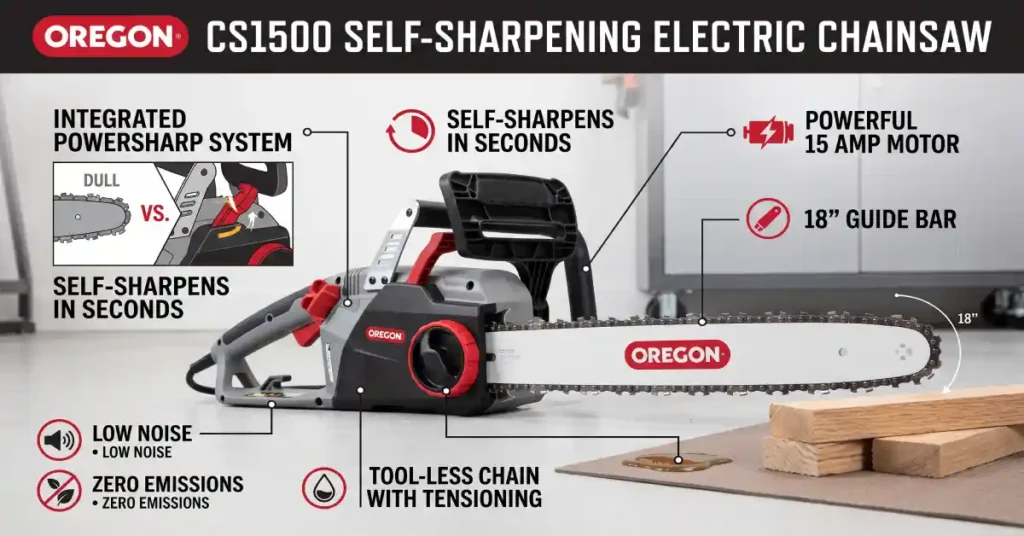
3. Oregon CS1500 18-Inch 15-Amp Self-Sharpening Corded Electric Chainsaw: Best Corded Pick

Key specifications (confirmed via Oregon’s manufacturer site, Tractor Supply, and Lowe’s listings)
- Power source: corded electric, 120V
- Motor: standard 15-amp
- Bar length: 18 inches
- Chain pitch: 3/8 inch, PowerSharp low-profile chain
- Weight: approximately 12.6 to 17 lb depending on the retailer’s listed configuration
- Warranty: 2-year limited
- Battery or charger: none, this is a corded-only tool
Features that matter
Oregon built this saw around its PowerSharp system, a self-sharpening chain you tension and sharpen on the saw itself with a lever pull, in about 3 to 5 seconds, according to Oregon. It also includes a tool-free chain tensioner via a ring on the side cover, an Auto Oiler that distributes bar & chain oil automatically while the saw runs, a chain brake, and instant trigger start with no gas-oil mixing. The chain sits under a sprocket cover that’s simple to remove for cleaning and chain changes.
Social proof
Lowe’s lists the CS1500 at 4.5 out of 5 stars across 162 reviews, with 89% of reviewers recommending it. Reviewers commonly praise its power for an electric saw, ease of use, and the convenience of the built-in oiling and tensioning system. Common criticism centers on the cord limiting mobility and the added step of learning the PowerSharp sharpening process.
Amazon’s own current rating and review count should be checked directly before publication, since retailer figures can differ from Amazon’s.
Best for
Homeowners with an outdoor outlet nearby, firewood cutters working close to the house, anyone who wants to avoid gas maintenance entirely, and buyers who value simple, on-saw chain maintenance over sending a chain out for sharpening.
Why it ranks
The CS1500 is one of the only widely available corded electric saws with an integrated self-sharpening system, and its 18-inch bar is long for a corded model in this price range. It satisfies buyers searching specifically for a no-battery, no-gas option they can trust from an established chain and bar manufacturer. Its main limitation is the cord itself, which rules it out for work far from a building.
Pros and cons
- Pro: Continuous corded runtime with no battery to manage
- Pro: Integrated PowerSharp self-sharpening system saves trips to a sharpening shop
- Con: The cord limits how far you can roam, and you’ll need an appropriately rated outdoor extension cord for full performance
Who should skip it
Anyone working regularly on a large property without convenient outlet access, or anyone who specifically wants a cordless tool for quiet, tether-free work, should look at a cordless model instead.
Comparison angle
Compared with the Craftsman CMECS600, the Oregon CS1500 has a longer bar (18 in versus 16 in) and adds a self-sharpening system the Craftsman doesn’t have, but it’s also the heavier of the two corded options. Compared with the cordless models in this guide, the CS1500 trades mobility for guaranteed runtime and a documented warranty from an established chain manufacturer.
Verdict
A dependable, well-documented corded pick for homeowners who work near power and want low-maintenance chain sharpening built in.
Safety note: Oregon’s documentation specifies a 15-amp circuit for the CS1500. Always use the correct gauge outdoor extension cord for the saw’s amperage, and keep the cord positioned behind you and away from the cutting path while working.
4. Cordless Handheld Tool-Free Chainsaw: Best for Light Pruning, If Properly Verified
Key specifications
This listing could not be confirmed through available research tools, so no rating, price, or spec sheet is published here. Before buying anything in this category, verify whether it’s a standard chainsaw or a mini pruning saw, the bar length, battery type, whether it’s built for one-handed or two-handed operation, the presence of a safety guard and chain brake, the oiling system, the manufacturer’s stated maximum branch diameter, battery protection features, manufacturer identity, and whether replacement chains are actually sold for that specific model.
Features that generally apply to this category
Compact handheld cordless saws are built for small branches, garden pruning, shrub maintenance, and quick cleanup, not for felling trees or cutting large firewood rounds. They commonly pair with an extension pole accessory for reaching higher branches without a ladder, which is worth checking for on the specific listing if that’s part of your use case.
Social proof
Amazon rating, review count, stock status, and kit contents should be verified immediately before publication.
Best for
Gardeners and homeowners doing light pruning and quick branch cleanup who don’t need a full-size saw.
Why it ranks
A compact, lightweight design is genuinely useful for one-handed pruning work, provided the underlying listing and safety features check out. It satisfies searches specifically looking for a lightweight or beginner-friendly cordless option rather than a full property-clearing saw.
Important safety note: one-handed operation does not remove kickback risk. A compact chainsaw is still a chainsaw, and full protective gear and careful hand placement still apply regardless of size.
Pros and cons
- Pro: Lightweight, compact format suited to overhead pruning and small branches
- Pro: Typically priced well below full-size cordless or corded saws
- Con: Not rated for large branches, trunk work, or firewood processing, and cannot be recommended for tree felling of any kind
Who should skip it
Anyone planning to cut firewood, fell a tree, or process branches over a few inches thick should choose a full-size saw like the Oregon CS1500 or a verified 20-inch Battery Chainsaw instead.
Verdict
A reasonable option for light pruning once the listing is verified, but not a substitute for a full-size saw on serious yard work.
5. Craftsman CMECS600 Electric Chainsaw: Best Corded Craftsman Option for Homeowners
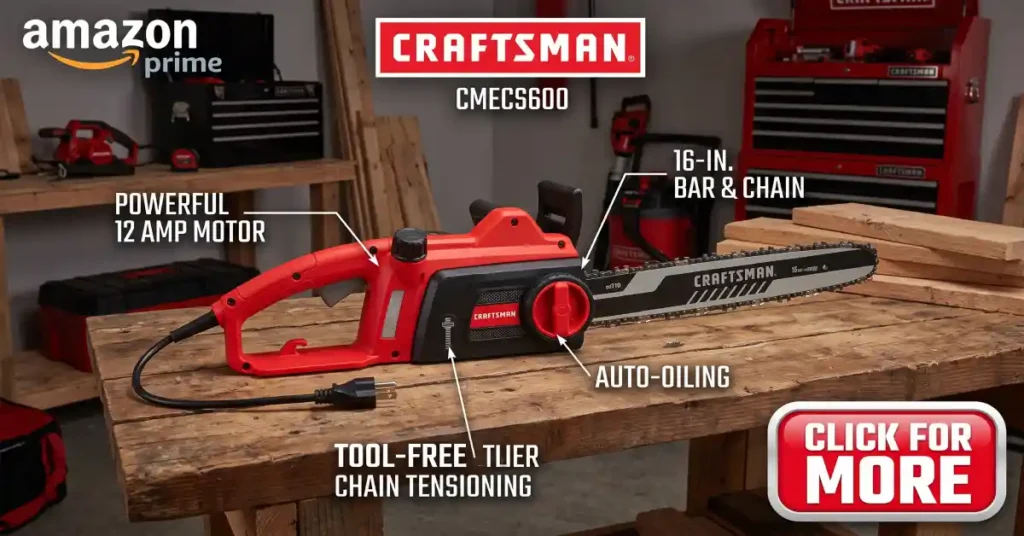
Key specifications (confirmed via Craftsman’s own site, Ace Hardware, and Farm & Fleet listings)
- Power source: corded electric
- Motor: 12-amp, brushed
- Bar length: 16 inches
- Maximum cutting diameter: approximately 14 inches per Ace Hardware’s listed spec
- Chain: low-kickback design, 0.043-inch gauge, 56 drive links
- Weight: 6.19 lb per Ace Hardware and Farm & Fleet; Craftsman’s own site lists 11.7 lb for the packaged product, so confirm the figure on the exact page you’re buying from
- Warranty: 3-year limited
- Chain brake: not listed as a feature on Craftsman’s or Ace Hardware’s spec sheets
Features that matter
A built-in oil window functions as a simple oil sensor, letting you check bar & chain oil at a glance without opening the reservoir. It also has a tool-free chain tensioner via a side dial, a low-kickback bar and chain, and no-prime, trigger-start operation with no gas engine to worry about. It’s compatible with Craftsman’s Versatrack wall storage system for garage storage between uses.
Social proof
A third-party hands-on review from Talk of the House describes the CMECS600 cutting through 8-inch oak limbs without bogging down and highlights its light weight for overhead work, alongside a noted drawback that the chain continues spinning briefly after the trigger is released. Amazon’s current star rating, review count, and price should be verified directly before publication.
Best for
Homeowners handling occasional pruning and smaller firewood tasks, buyers who want a recognizable tool brand, and anyone who prefers corded power without buying into a battery platform.
Why it ranks
It’s one of the lightest corded electric chainsaws widely sold, which matters for overhead cutting and ladder work, and its 3-year warranty beats many competitors at a similar price. Its 16-inch bar and 14-inch rated cutting diameter mean it’s built for branches and smaller logs, not large trunk sections.
Pros and cons
- Pro: Very light at roughly 6.19 lb, easier to control overhead than most corded saws
- Pro: Built-in oil window removes the guesswork of checking lubrication
- Con: No listed chain brake, and the chain coasts briefly after you release the trigger, according to hands-on feedback
Who should skip it
Anyone regularly cutting logs larger than about 14 inches in diameter, or anyone who specifically wants a chain brake as a safety feature, should size up to the Oregon CS1500 or a verified 20-inch Battery Chainsaw.
Comparison angle
Compared with the Oregon CS1500, the CMECS600 is lighter and cheaper but has a shorter bar and no self-sharpening system. Compared with the cordless options in this guide, the Craftsman gives up mobility in exchange for a fully documented warranty and spec sheet.
Verdict
A genuinely lightweight, well-warrantied corded option for light-to-medium homeowner yard work, though not built for heavy log or tree work.
Additional Amazon Listings to Verify
Two additional listings were supplied for this comparison and referenced by ASIN. Neither returned a confirmable current page through available research tools, so no product title, rating, review count, or specification is published here.
Before including either in a live version of this article, pull the exact product title, brand, power source, bar length, current rating, review count, and availability directly from the live Amazon page, and note why each one was excluded from the main five, whether that’s overlapping specs with an existing pick, unclear brand identity, or insufficient independent coverage compared with established Battery & Electric Chainsaws brands.
How to Choose the Right Electric Chainsaw
Match the Saw to the Job
- Continuous cutting near an outlet: Oregon CS1500
- Lightweight homeowner yard work: Craftsman CMECS600
- Mobile cordless cutting, once verified: Flagship Brushless Cordless Chainsaw
- Longer sessions without a recharge, once verified: Two-Battery Cordless Chainsaw
- Light pruning and small branches, once verified: Cordless Handheld Tool-Free Chainsaw
Choose the Battery System First for Cordless Models
The cheapest cordless chainsaw on the shelf isn’t always the cheapest system once you add a spare battery or charger. If you’re going cordless, consider what other battery-powered chainsaws, power tools, or even lawn mowers you already own on the same platform, the cost of a compatible charger if you’re starting fresh, which battery capacities are available, and how easy it is to find a replacement pack locally if one wears out.
Some brands offer MAX Battery Series Solutions that let one battery system power a chainsaw, a pole saw, and yard tools ranging up to Stand-On Lawn Mowers, which can be worth factoring in if you’re already invested in that ecosystem for Lawn Mowing and general tree care around the property.
Bar Length, Chain Gauge, and Cutting Diameter
Saws with 6 to 8 inch bars suit small pruning and garden work. 10 to 14 inch models handle general homeowner limbing and small firewood. 16 to 18 inch models, like the two corded picks in this guide, are better for larger branches, storm cleanup, and medium firewood.
Larger work, including regular felling, usually calls for a more powerful cordless saw or a gas model, the kind Forestry Clearing Saws and Landscaping Professionals rely on for daily commercial use. Bar length alone doesn’t guarantee a saw can safely handle a tree of a given diameter; the manufacturer’s stated maximum cutting diameter, the chain gauge, and your own experience all matter just as much.
Brushed Versus Brushless Motors
Brushless motors generally run cooler, waste less energy as heat, and offer better battery life per charge than brushed motors, which is why most higher-end battery-powered chainsaws use them. Brushed motors, like the one in the Craftsman CMECS600, can cost less up front and still perform reliably for occasional homeowner use. Motor type alone doesn’t determine cutting performance; chain sharpness, chain gauge, how much pressure you apply, and remaining charge all affect real-world cutting efficiency just as much as whether the motor has brushes.
Weight and Balance
Bare-tool weight and weight with a battery installed are two different numbers on a cordless saw, and the gap can matter more than it looks on a spec sheet. A larger battery pack shifts the balance point, which affects fatigue during overhead work far more than it does during a quick cut at waist height.
The Craftsman CMECS600’s 6.19 lb weight makes it noticeably easier to control overhead than the heavier Oregon CS1500, which trades that lighter feel for a longer bar and a self-sharpening chain.
Compare Total Cost
Add up the tool price, battery and charger if applicable, a spare battery if you’ll need one for longer run times, bar oil, a replacement chain, an outdoor extension cord for corded models, and how warranty and replacement parts are handled if something goes wrong.
Can Electric Chainsaws Cut Firewood?
Yes, an appropriately sized electric chainsaw can cut firewood. Corded models work well near an outlet, and cordless models are more practical away from the house. A sharp chain matters more than the highest advertised voltage on the box. Thick hardwood may require a larger battery system or a gas saw to process efficiently. Always support logs securely and avoid cutting on unstable ground.
Can Electric Chainsaws Cut Down Trees?
Electric saws can handle some small and medium tree work, but felling a tree carries far more risk than trimming branches. Anyone attempting it needs to understand escape routes, the tree’s natural lean, wind conditions, nearby structures, and proper hinge-cut technique. Large, leaning, damaged, or otherwise hazardous trees should be left to a qualified professional or a crew running dedicated Forestry Clearing Saws. No buying guide should encourage an inexperienced reader to fell a large tree solo.
Do Electric Chainsaws Need Oil?
Yes. Most electric chainsaws still need bar & chain oil, because the chain and guide bar require continuous lubrication to run smoothly and avoid premature wear, regardless of how they’re powered. An Auto Oiler handles distribution automatically, and some saws add an oil sensor or oil-level window so you can check the reservoir at a glance, but you still need to top it off regularly.
Motor power doesn’t replace lubrication; running a saw with insufficient bar oil causes heat buildup, faster wear, and poor cutting speed. Read more in our dedicated piece on do electric chainsaws need oil.
Chain Types and Maintenance
The chain on an electric chainsaw matters nearly as much as the saw itself, since the wrong chain, or a dull one, can turn a capable tool into a slow, frustrating one.
Low-kickback chains, used on both the Oregon CS1500 and the Craftsman CMECS600, are designed with a reduced-aggression cutter profile that lowers the chance of the saw jumping back toward the user during a cut.
Chain pitch and gauge need to match the specific bar and sprocket on your saw. The Oregon CS1500 uses a 3/8-inch pitch PowerSharp chain, while the Craftsman CMECS600 uses a 0.043-inch gauge chain with 56 drive links. Always confirm the exact chain gauge and drive-link count before ordering a replacement chainsaw chain, since the wrong size won’t tension correctly even if the pitch looks close.
Bucking spikes, sometimes called bumper spikes, are the small metal teeth near the bar mount on larger saws that dig into a log and act as a pivot point while bucking firewood into shorter lengths. Not every compact or homeowner-grade electric saw includes them, so check the spec sheet if bucking logs is a regular part of your work.
Tool-free chain tensioners, found on both corded picks in this guide as well as most modern battery-powered chainsaws, let you adjust chain tension with a dial or ring rather than a separate wrench, which speeds up routine maintenance considerably.
The sprocket cover is the panel you remove to access the chain, bar, and drive sprocket for cleaning, tensioning, or a full chain swap. Keeping this area free of sawdust and debris extends the life of both the chain and the sprocket underneath it.
Cutting Technique and Safety
- Wear eye and hearing protection every time you run the saw, even for quick cuts, since sustained exposure without protection can affect hearing even at the relatively lower noise level of an electric motor compared with a gas engine
- Keep both hands on the saw whenever the model is designed for two-handed use
- Use one-handed or compact cordless tools only when the workpiece itself is stable and won’t shift under the chain
- Check for hidden wires, fences, or nails in the wood before cutting
- Secure loose material so it can’t shift or bind the chain mid-cut
- Keep bystanders well clear of the cutting area, especially during felling or storm cleanup
- Remove the battery before performing maintenance on a cordless saw, or unplug a corded saw before touching the chain
- Keep the cord positioned behind you and clear of the cutting path on a corded model
- Follow the manufacturer’s guidance on maximum branch or log diameter for your specific saw
Maintenance
- Check chain tension before each use, and adjust with the tool-free chain tensioner where equipped
- Top off bar & chain oil regularly, and don’t rely on an Auto Oiler or oil sensor to catch a completely empty reservoir
- Keep the chain sharp; a dull chain cuts slower and increases the physical effort needed, which raises fatigue and kickback risk
- Clean sawdust and debris from under the sprocket cover after use
- Inspect the drive sprocket periodically for wear
- Store the saw properly between uses, and keep batteries at room temperature rather than in a hot shed or truck cab
- Take extra care with corded models in wet weather
- Watch the battery indicator on cordless models so you’re not caught mid-cut with a dead pack
Electric power reduces fuel maintenance, but it does not reduce the need for chainsaw safety training and protective equipment.
Frequently Asked Questions
Are electric chainsaws any good?
Yes, they’re genuinely useful for pruning, storm cleanup, firewood, and many homeowner tree care tasks. Corded models offer continuous runtime, while cordless and battery-powered chainsaws offer more freedom of movement.
What is the best electric chainsaw for homeowners?
It depends on your property and task. A corded Oregon CS1500 suits users who work near an outlet, while a verified cordless model is better for mobile yard work away from the house. The Craftsman CMECS600 is worth a look for lighter, more occasional homeowner use.
Can an electric chainsaw cut through a tree?
Some electric chainsaws can handle small and medium trees, but the saw has to match the tree size, and the user needs to understand safe felling practices. Large, leaning, damaged, or hazardous trees call for a trained professional.
How long does a cordless electric chainsaw battery last?
Runtime depends on battery capacity, chain sharpness, wood density, cutting technique, and the saw’s overall design. A larger battery typically means longer run times, but the safest guidance is to check manufacturer or independent test data rather than assume a universal number, since we did not perform a formal runtime assessment for this guide.
Do electric chainsaws need oil?
Yes. They still need bar & chain oil to reduce friction and protect the chain and guide bar. Check the oil reservoir before and during cutting sessions.
Is a corded or cordless electric chainsaw better?
A corded model is better for continuous work near an outlet. A cordless model is better when you need mobility or you’re working far from a building.
Which electric chainsaw is best for a woman or smaller user?
The right choice depends on reach, grip strength, body size, experience, and the specific cutting task, more than gender. The lighter, 6.19-lb Craftsman CMECS600 is generally easier to control for smaller users or overhead work than the heavier Oregon CS1500, but any saw should be tried in-hand before buying when possible.
Is the Oregon CS1500 worth buying?
Based on confirmed retailer and manufacturer data, yes, for homeowners who work near an outlet and want continuous runtime plus a built-in self-sharpening system. Its 2-year warranty and documented spec sheet make it one of the more transparent corded picks in this category.
What should I check before buying an Amazon chainsaw?
The exact product title, brand and model number, power source, bar length, current star rating, review count, stock status, kit contents, warranty terms, and replacement chain or battery availability, all pulled from the live listing rather than assumed from the product name.
Final Verdict
- Best corded electric choice: Oregon CS1500, subject to current availability and a fresh listing check before purchase
- Best corded homeowner choice: Craftsman CMECS600, for its light weight and long warranty on smaller-diameter work
- Best cordless choice, best complete kit, and best compact pick: pending live verification of the three unconfirmed cordless listings referenced in this guide
Table of Contents