

The quickest way to start a Stihl chainsaw is to engage the chain brake, set the master control lever to the choke (for a cold engine), give a firm pull on the starter cord until it ‘pops’ (fires once), then push the lever up one notch to the run position (without the choke) and pull again until the engine runs smoothly.
This neighborly guide breaks down every step, covering safety, preparation, troubleshooting, and pro tips to make starting your Stihl as seamless as possible every time.
Safety First: Critical Pre-Start Checklist
Operating a chainsaw is inherently dangerous. Never attempt to start or use a chainsaw without proper safety gear and preparation.
Mandatory Personal Protective Equipment (PPE)
| Item | Purpose | Importance |
| Helmet with Visor | Protection from falling limbs and flying debris. | HIGH |
| Safety Glasses/Goggles | Essential eye protection (even under a visor). | HIGH |
| Ear Protection | Chainsaws operate at dangerous decibel levels. | HIGH |
| Chainsaw Chaps/Pants | Protects legs from accidental chain contact. | CRITICAL |
| Heavy-Duty Work Gloves | Improved grip and vibration dampening. | HIGH |
| Steel-Toe Boots | Foot protection from dropping the saw or materials. | HIGH |
💡 Expert Tip: Always check your local regulations. In many commercial settings, full-body protection is legally required. For beginners, treating every start like a professional job builds the best habits.
Environment & Saw Preparation
- Clear Work Area: Ensure at least 10 feet of clear space around you.
- Secure the Saw: The saw must be placed on a firm, flat surface (ground or stump) free of debris.
- Chain Brake Engaged: The chain brake must be engaged before starting to prevent the chain from spinning accidentally.
Step-by-Step Stihl Chainsaw Starting Process (Cold Start)
A “cold start” means the engine hasn’t run recently and needs the full choking process to start. This is the most common procedure.
Phase 1: Preparation and Choke Setting
- Engage Chain Brake: Push the hand guard forward until it clicks into place. This is CRITICAL.
- Prime the Engine (If Required): Some older or specific Stihl models (check your manual) have a manual fuel pump (primer bulb). Pump it 3-5 times until fuel is visible.
- Set Master Control Lever: Locate the master control lever (usually a switch on the side or rear). For a cold engine, push this lever all the way down to the bottom-most position, often marked with the choke symbol (I|). This simultaneously applies the choke and sets the throttle lock (half-throttle) for starting.
Phase 2: The Start Pulls
- Secure the Saw (Ground Start – Recommended): Place the saw on the ground. Put your right foot through the rear handle opening and press down firmly to hold the saw to the ground. This provides maximum stability.
- The First Pull (The “Pop”): Grip the starter handle firmly with your right hand. Pull the starter cord straight out with a smooth, firm, and controlled motion (do not pull to the very end of the cord’s reach).
- Listen for the Pop: Repeat the pull (usually 1–3 times) until the engine briefly fires or “pops” once or twice. This means the fuel/air mixture has combusted.
🛑 STOP PULLING IMMEDIATELY AFTER THE POP! Continuing to pull on the choke setting will flood the engine.
Phase 3: Warm-Up and Idle
- Move Lever to Half-Choke/Run: As soon as the engine pops, immediately push the master control lever up one notch to the starting/run position (often marked with 1/2| or the normal run position |). The choke is now off, but the throttle remains locked for high idle.
- Final Pulls: Pull the starter cord again. The engine should now start and run.
- Disengage Throttle Lock: Once the engine is running, blip the throttle trigger (press and release quickly). This drops the engine speed back to a smooth idle.
- Disengage Chain Brake: Now that the engine is running and idling, pull the front handguard back to disengage the chain brake. The saw is now ready to use.
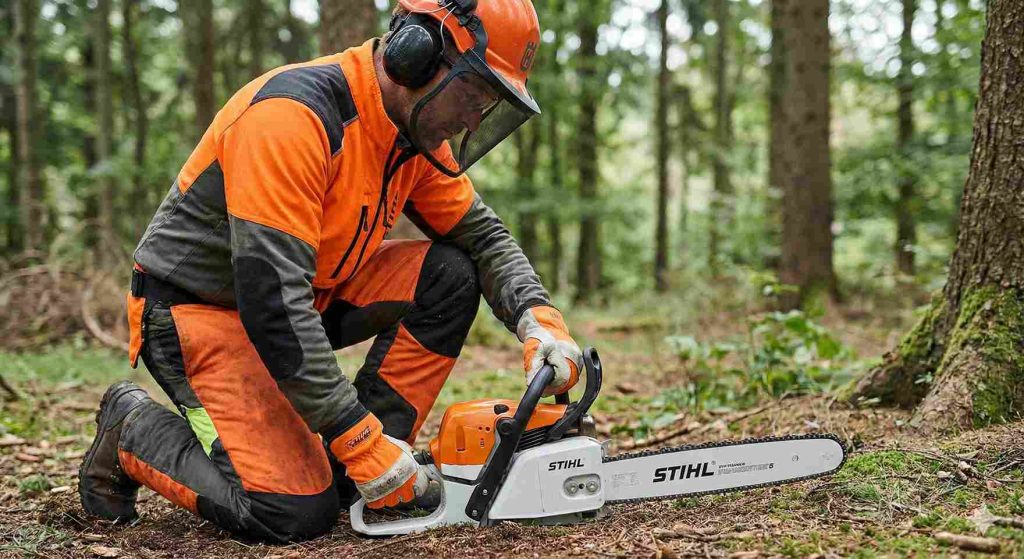
Ground Start vs. Standing Start
The most common and safest method is the Ground Start (foot-in-handle). The Standing Start (or “between the knees”) is sometimes used by experienced operators for quick starts, but is less stable and riskier for beginners.
| Feature | Ground Start (Recommended) | Standing Start (Experienced Users Only) |
| Stability | Excellent – Saw is firmly anchored. | Fair – Depends on the operator’s leg strength. |
| Safety | High – Distance from the chain is maximized. | Lower – Saw is closer to the body/face. |
| Technique | Right foot through the rear handle. Pull straight up. | Saw held between the knees/thighs. Pull sideways. |
| Best For | Cold starts, troubleshooting, and all beginners. | Quick warm starts in the field. |
🎥 YouTube Search Tip: If you’re a visual learner, search for “Stihl chainsaw ground start technique” on YouTube. The visual guidance makes a huge difference!
Warm Start Procedure
A “warm start” is used when the saw has run within the last few minutes. DO NOT use the choke setting.
- Set the master control lever to the normal run position (one notch above the choke).
- Engage the chain brake.
- Pull the starter cord until the engine starts. (Typically 1-2 pulls).
Fuel & Maintenance: The Engine’s Lifeblood
Starting issues often stem from fuel and maintenance issues.
2-Stroke Fuel/Oil Ratios
Stihl chainsaws use a 2-stroke engine and require a mix of gasoline and 2-stroke engine oil.
- Standard Stihl Ratio: 50:1 (50 parts unleaded gasoline to 1 part Stihl HP Ultra or equivalent 2-stroke oil).
- Quantity Example: For a 1-gallon (128 oz) fuel can, you need $2.6\text{ oz}$ of Stihl 2-cycle oil.
⚠️ Never use straight gasoline, old fuel (over 30 days), or ethanol blends higher than $10\%$. Poor fuel quality is the #1 cause of starting and running issues.
Blade, Chain, and Bar Inspection
Before every start, quickly check:
- Chain Tension: The chain should be snug against the bottom of the bar but still pull freely by hand.
- Bar Oil Level: Ensure the chain and bar oil reservoir is full. The chain must be lubricated!
- Air Filter: A dirty air filter starves the engine of air, making starting difficult. Clean or replace it regularly.
Troubleshooting Common Starting Issues
If your saw doesn’t start, don’t panic. You likely have one of two common issues:
1. Flooded Chainsaw Fix
A flooded engine has too much fuel and not enough air to ignite. This happens if you pull the starter cord too many times on the choke setting after the initial pop.
| Step | Action | Rationale |
| 1. | Disengage the Choke. | Push the master control lever all the way up to the run position (no choke/no half-choke). |
| 2. | Remove the Spark Plug. | Use the tool provided with your saw to remove the spark plug and let the cylinder vent for 5 minutes. |
| 3. | Dry the Cylinder. | Keeping the plug out, pull the starter cord 10–15 times to blow out excess fuel. Wipe the spark plug dry. |
| 4. | Reassemble and Try Again. | Reinstall the dry plug. Pull the starter cord (now on the normal run setting) firmly. It may take several pulls. |
2. Engine Will Not Start at All
| Potential Cause | Quick Check/Fix |
| No Spark | Remove the spark plug and check for damage/fouling. Replace if necessary. Ensure the wire connection is secure. |
| Old/Bad Fuel | Drain all old fuel and replace it with a fresh 50:1 mix (preferably Stihl premixed fuel). |
| Dirty Air Filter | Remove and clean the air filter. A saw can’t run if it can’t breathe. |
❓ “Why is my Stihl chainsaw hard to start?” The most common reason is pulling too many times on the choke setting, leading to flooding. Always remember the “Pop and Switch” rule!
Product-Specific Quirk: Stihl Farm Boss (MS 271/291)
The STIHL Farm Boss series (like the MS 271 or MS 291) is a popular model. While the starting sequence is the same, many newer models feature the ErgoStart system.
- ErgoStart Benefit: This system uses an additional spring between the crankshaft and the starter cord spool, requiring less force to pull the cord.
- Quirk: You don’t need a huge, hard pull. A steady, deliberate, and smooth pull is all that’s required to activate the spring and start the saw.
Next Steps & Resources
Ready to dive deeper into chainsaw ownership? Utilize these resources to maintain your machine and ensure your safety.
| Action | Contextual Link/Call-to-Action |
| Watch a Demo | ▶️ Watch our quick startup demo on YouTube for a visual step-by-step guide. |
| Shop for Upgrades | Compare new Stihl chainsaws on Amazon for models with ErgoStart or M-Tronic features. |
| Master Maintenance | More maintenance tips: Learn how to clean your air filter for better performance. |
| Stay Sharp | Ready for the next level? Learn how to sharpen your chain for peak cutting power. |
Expert FAQs (Structured Data Ready)
How long can I leave gas in my STIHL chainsaw?
It is recommended not to leave standard mixed fuel in the chainsaw for more than 30 days. Fuel stabilizer can extend this, but for best performance and to prevent carburetor issues, use Stihl’s premixed, ethanol-free MotoMix, which can last up to 2 years.
What does it mean when my chainsaw pops but won’t start?
The “pop” means the fuel/air mix ignited successfully. This is your cue to immediately move the master control lever from the choke setting up to the half-choke/run position. If you continue pulling on the choke after the pop, the engine becomes flooded and needs the flooded start procedure.
Can I start a Stihl without the chain brake engaged?
While physically possible, you should never attempt this. The chain brake prevents the chain from spinning during the high idle starting phase. Disabling this safety feature increases the risk of serious injury.
What is the difference between a cold start and a warm start?
A cold start uses the choke (lever all the way down) to restrict air and introduce more fuel into the cylinder, which is necessary for the first ignition. A warm start (engine recently running) bypasses the choke and starts directly on the normal run position because the engine is already primed with fuel and heat.
Table of Contents