

Cutting hardwood or seasoned firewood chews through a weak chain fast. Choose the wrong one and you’ll be stopping every ten minutes to re-tension, re-sharpen, or fight a chain that wanders off-line. The right chain, on the other hand, turns a stack of oak or hickory rounds into an afternoon job instead of a weekend one.
This guide covers the seven chains worth buying for hardwood and firewood in 2026, how to match a chain to your saw before you order, and the questions people actually ask before checking out.
Quick answer: If you just want one recommendation — for most homeowners running an 18-inch bar, the Oregon S62T AdvanceCut is the safest, most compatible pick. If you’re running a Stihl saw professionally, go with the Stihl 26RS Rapid Super.
How I Chose These Chains
Every chain below is evaluated against four things that actually matter when you’re cutting dense wood:
- Cutter type — full-chisel chains cut hardwood fastest but dull quicker on dirty or bark-covered logs; semi-chisel chains trade a bit of speed for durability and easier maintenance.
- Kickback rating — whether the chain meets ANSI/UL low-kickback standards, which matters most for homeowners and occasional users.
- Fitment range — how many saw brands and models the chain is confirmed to fit, since a chain that’s the wrong pitch or gauge simply won’t run.
- Verified availability — every product below was checked against current retailer and manufacturer listings before publishing.
Top Quick Chainsaw Chain List By Expert
Best Chainsaw Chain for Hardwood and Firewood at a Glance
| Chain | Bar Length | Cutter Type | Best For | Verdict |
|---|---|---|---|---|
| Oregon S62T AdvanceCut | 18″ | Semi-chisel | Homeowners, DIY yard work | Best overall |
| Husqvarna H30 (18″) | 18″ | Chisel | Lightweight bore cutting, arborists | Best for low vibration |
| Oregon S56 AdvanceCut | 16″ | Semi-chisel | Small saws, precision cuts | Best for 16″ bars |
| Husqvarna H25/H36 (20″) | 20″ | Chisel | Bigger felling and bucking jobs | Best for felling |
| Stihl 26RS Rapid Super (18″) | 18″ | Full-chisel | Heavy-duty, professional use | Best heavy-duty |
| Husqvarna H30 (16″) | 16″ | Chisel | Occasional users, arborists | Best for occasional use |
| Stihl 26RS 74 Rapid Super | 18″ | Full-chisel | Fast cuts in clean hardwood | Best for clean cuts |
Pricing, stock, and exact specs change often on retailer listings. Confirm current details on each product page before buying.
Our Top 7 Picks of Chainsaw Chain For Hardwood & Firewood
There are tons of products available in the market for our subject, but choosing the right one can be cumbersome. So, I have researched and found the most intriguing and well-suited ones for you and reviewed them as well to help you know that what kind of chain is best for cutting hardwood and firewood. Let’s get into it!
1. Oregon S62T AdvanceCut Chainsaw Chain for 18-Inch Bar
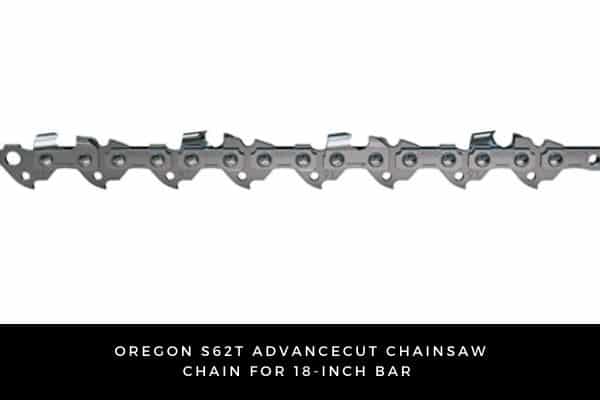
Best for: homeowners who want low kickback and broad compatibility
The S62T is the chain most homeowners land on because it fits so many saws — Husqvarna, Echo, Poulan, Homelite, Remington, and Craftsman models with an 18-inch, 3/8″ low-profile setup all take it. It’s a 62-drive-link, .050″ gauge chain, so double-check those numbers against your bar before ordering.
It’s a semi-chisel design, meaning the rounded cutter corners tolerate dirt and bark better than a full-chisel chain, at a small cost in raw cutting speed. That trade-off is exactly right for cutting storm-damaged trees or firewood rounds that have been sitting on the ground.
The chrome-plated cutters and hardened rivets hold an edge through repeated sharpening, and Oregon’s Lubri-Tec system keeps oil reaching the parts that actually wear. It’s also built to ANSI and UL low-kickback standards, which matters if you’re not running a chainsaw every day.
Pros
- Wide compatibility across brands.
- Chrome coating adds durability.
- Meets ANSI/UL low-kickback standards.
- Widely available in 2- and 3-packs.
Watch for: Semi-chisel cutters are slightly slower than full-chisel in clean, seasoned hardwood
2. Husqvarna Chainsaw Chain 18-Inch
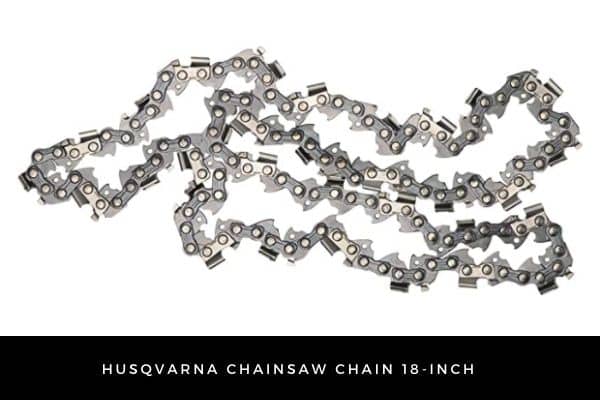
- Best for: arborists and users of lightweight professional saws
- The solution that it provides: lightweight bore cutting
- Targeted audience: Arborists
Husqvarna’s 18-inch chain is built for saws that need to stay light in the hand for hours at a time. It’s tuned for low vibration and low kickback without sacrificing the aggressive bore-cutting performance that arborists rely on for notch cuts and plunge cuts.
It’s rated for high-production environments, which is Husqvarna’s way of saying it holds up to repeated use rather than just occasional yard work — but it performs just as well for someone who only picks up a saw a few weekends a year.
Pros
- Comfortable for extended use.
- Strong bore-cutting performance.
- Good for both pros and occasional users.
3. Oregon S56 AdvanceCut Chainsaw Chain for 16-Inch Bar
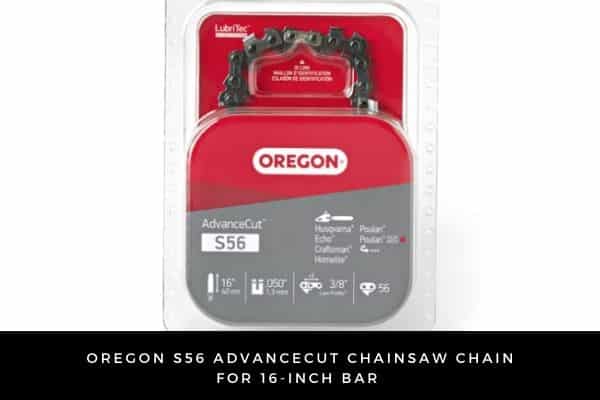
- Best for: homeowners running smaller saws
- The solution that it provides: 16-inch bar small chainsaws
- Targeted audience: Homeowners
If your bar measures 16 inches, this is the direct counterpart to the S62T above — same chrome-coated, semi-chisel construction, same broad compatibility (Husqvarna, Echo, Poulan, Greenworks, Homelite), scaled down for a smaller saw. It meets the same ANSI/UL kickback standards and uses the same automatic-oiling-friendly design.
Smaller saws are usually the ones doing precision work — limbing, pruning, cutting kindling-sized rounds and this chain’s semi-chisel cutters are well suited to that kind of controlled, repeated cutting.
Pros
- Ergonomic on small saws.
- Dust and dirt tolerant.
- It goes on the standards of ANSI and UL.
- High precision for detail cuts.
4. Husqvarna Chainsaw Chain 20-Inch
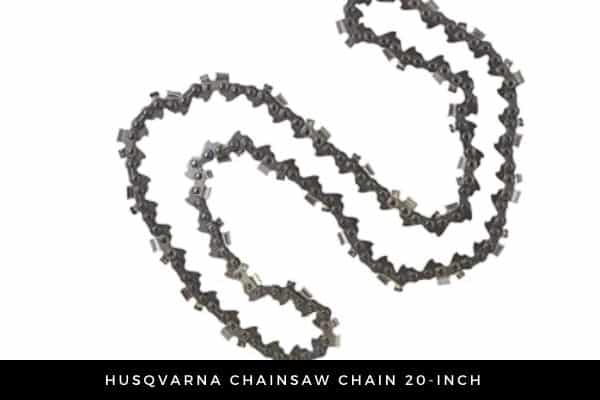
- Best for: arborists and users tackling larger logs
- The solution that it provides: lightweight bore cutting
- Targeted audience: arborists
Step up to a 20-inch bar and you’re usually cutting bigger rounds or felling larger trees, and this chain is built for that scale. It carries the same anti-vibration and low-kickback design as Husqvarna’s smaller chains, with sharper, more aggressive cutters suited to bigger jobs.
Husqvarna markets this one toward the same lightweight, high-production saws its shorter chains are built for — so if you already like their 16- or 18-inch chain, this is the natural upgrade when you move to a longer bar.
Pros
- Handles bigger logs confidently.
- Anti-vibration design.
- Fewer tension adjustments needed.
5. Stihl Chainsaw Chain 26RS68 18-Inch
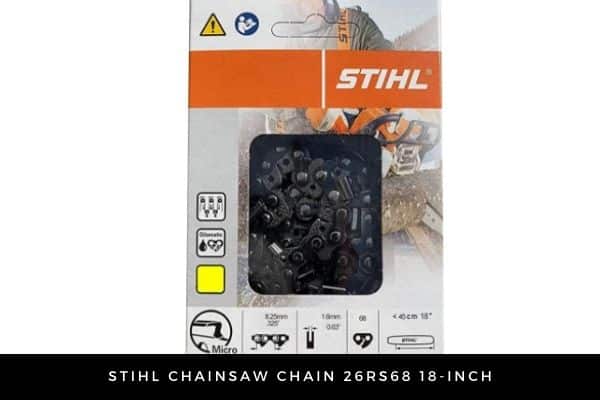
- Best for professionals and serious firewood processors who want maximum cutting speed
- The solution that it provides: prevents pull-in
- Targeted audience: heavy-duty and good cutters
This is a full-chisel chain, and it shows — the square-cornered cutters are built for speed in clean, seasoned hardwood, cutting noticeably faster than a semi-chisel chain of the same size. Stihl’s Oilomatic lubrication grooves route oil directly to the rivets, which reduces heat buildup and stretch over long cutting sessions.
The trade-off with any full-chisel chain is maintenance: those square corners cut fast but dull faster in dirty or bark-covered wood, and they need more frequent, careful sharpening to keep performing. If most of your cutting is clean, dry hardwood rounds rather than logs dragged off the ground, that trade-off is well worth it.
Pros
- Handles bigger logs confidently.
- Heavy-duty chain.
- Robust & Anti-vibration design.
- Durability and long-lasting action.
- Fewer tension adjustments needed.
Watch for: Needs more frequent sharpening than semi-chisel alternatives; less forgiving in dirty conditions
6. Husqvarna Chainsaw Chain 16-Inch
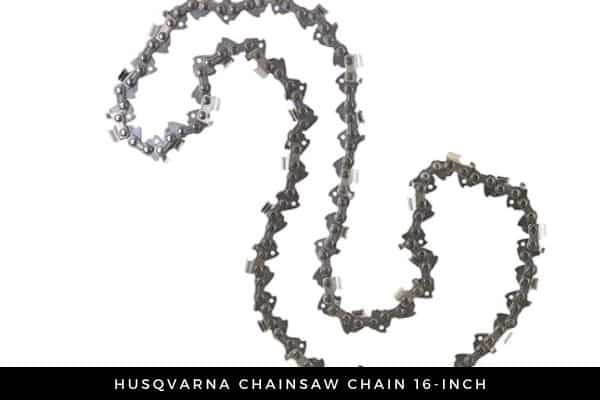
Best for: homeowners doing seasonal yard cleanup
Husqvarna’s 16-inch option (commonly the H30 series, 0.050″ gauge, 0.325″ pitch) is the right-sized chain for smaller yard saws used a few times a season — clearing storm damage, cutting firewood rounds, general property upkeep. Like its larger siblings, it’s built for low vibration and low kickback, and it holds up well in high-production settings if you do end up using it more than expected.
Always confirm your saw’s exact pitch and gauge before ordering — Husqvarna makes multiple 16-inch chains, and buying by bar length alone is the most common fitment mistake.
Pros
- Best for low vibrations and low kickback.
- Solid cutting performance for the price.
- Best for high production environments.
- Great for arborists.
- Good general-purpose yard chain.
7. Stihl 26RS 74 Chainsaw Chain Rapid Super for 18-Inch Bar
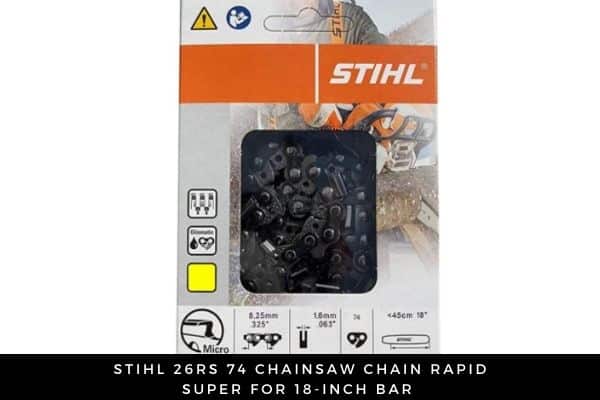
- Best for heavy-duty users who prioritize control
- The solution that it provides: prevents pull-in
- Targeted audience: heavy-duty and good cutters
This is Stihl’s other 18-inch Rapid Super option, at 0.325″ pitch and 0.063″ gauge — a slightly different spec than #5 above, so check your bar before choosing between them. It shares the same full-chisel speed and Oilomatic lubrication as Stihl’s other Rapid Super chains, with a design tuned to prevent pull-in during aggressive cuts.
It performs best on clean hardwood; for dirtier, ground-contact firewood, expect to sharpen more often than you would with a semi-chisel Oregon chain.
Pros: · ·
Pros
- Heavy-duty build.
- Good durability.
- Ergonomic design.
- Sharp, long-lasting cutters.
- Reliable control during aggressive cuts.
How to Choose the Right Chainsaw Chain
1. Match your saw’s brand and model. Not every chain fits every saw, even at the same bar length — always cross-check the compatible model list before buying.
2. Get the guide bar length right. The guide bar (often just called the bar) is what the chain rides on — a chain built for a different bar length will either sit too loose or too tight on your cutting bar, neither of which gives you correct tension.
3. Confirm the gauge. Gauge is the thickness of the drive links where they sit in the guide bar’s groove. The wrong gauge chain either won’t seat in the bar or will run dangerously loose.
4. Confirm the pitch. Pitch is the distance between three consecutive rivets, divided by two — it has to match your bar and drive sprocket exactly.
5. Check the drive link count. This determines whether the chain physically closes around your specific bar length; it’s listed on every chain’s packaging and product page.
6. Decide between full-chisel and semi-chisel. Full-chisel cuts faster in clean hardwood but dulls faster in dirt and bark. Semi-chisel chainsaw chains cut a bit slower but tolerate rough, ground-contact wood far better — which matters a lot for firewood processing.
7. Check the chain sequence. Sequence refers to how cutters are spaced along the loop — standard sequence puts a cutter on nearly every link for maximum cutting power, while skip or semi-skip sequences space cutters farther apart, cutting a little slower but reducing drag and vibration on longer bars. Match the sequence to your bar length and saw power rather than guessing.
8. Match the chain to your saw’s power source. Gasoline-powered saws generally have more torque to spare and can run more aggressive full-chisel chains without bogging down. Battery-powered chainsaws typically have less reserve power, so a semi-chisel or lower-drag chain often performs better and extends runtime per charge.
9. Look for low-kickback and anti-vibration safety features. These matter most if you’re not using a saw every day; ANSI/UL-rated chains reduce the chance of a sudden kickback catching you off guard, and low-vibration designs cut down on operator fatigue during long sessions.
Everything You Should Know About the Types of Saw Chains Before You Buy
The seven chains above cover most hardwood and firewood jobs, but they’re all variations on a small number of underlying cutter designs. Knowing what those designs are — and when it’s worth stepping up to something more specialized — makes it much easier to judge any chain you’re looking at, not just the ones on this list.
Understanding Saw Chain Anatomy and Performance
Every saw chain, regardless of brand or price, is built from the same three components:
- Cutters — the teeth that do the actual cutting. Their shape, angle, and material determine how fast the chain cuts and how long it holds an edge.
- Drive links — the bottom portion of each link that seats into the bar’s groove and engages the drive sprocket, pulling the chain around the bar.
- Tie straps and rivets — the connecting pieces that hold cutters and drive links together as a single loop and allow the chain to flex around the bar and sprocket.
Performance comes down mostly to the cutter: its shape (the grind profile), the spacing between cutters (the sequence), and the material it’s made from. A chain with the right pitch and gauge for your saw but the wrong cutter type for your wood will still underperform — so it’s worth understanding the options before you buy.
Types of Saw Chain Cutters Explained
Full Chisel Cutter
Full-chisel cutters have a square, sharp-cornered top edge, which lets them bite in and remove wood fastest. They’re the go-to choice for clean, seasoned hardwood, where their speed advantage over other cutter types is largest.
The trade-off is durability in rough conditions. Those square corners are more easily chipped or dulled by dirt, sand, bark, and ground contact, so full-chisel chains need more frequent sharpening if you’re cutting logs that have been lying outdoors. They’re best suited to professional or high-output cutting where the wood is relatively clean.
Semi-Chisel Cutter
Semi-chisel cutters have a rounded top corner instead of a square one. That rounded profile cuts a little slower than full-chisel, but it holds up far better against dirt, bark, frozen wood, and the kind of grime that firewood rounds usually pick up sitting on the ground.
For most homeowners processing firewood — which is rarely perfectly clean — semi-chisel is the more practical everyday choice. It needs sharpening less often and is more forgiving of an accidental dirt or rock contact, which is why several of the picks above (the Oregon AdvanceCut chains, in particular) use this cutter style.
Square Ground Cutter
Square-ground chains are sharpened with a flat file or grinding wheel set at specific angles that produce sharp, squared cutting corners similar in shape to a full-chisel tooth — but the term refers to the sharpening method as much as the cutter shape itself. Chains that are square-filed hold an especially aggressive edge and are popular with competition cutters and professionals chasing maximum speed.
The catch is maintenance: square grinding is more technical than a standard round-file sharpening and is usually done with a bench grinder rather than a handheld file. It’s a good option if you already have the equipment and experience, but it’s overkill for casual firewood cutting.
Specialty Cutters (Carbide-Tipped, Chamfer, Dragon, Terminator)
For cutting conditions that wear out standard steel chains quickly — dirty hardwood, root wads, occasional nails, or reclaimed lumber — carbide-tipped chains are the step up. Tungsten carbide cutting edges give the chain far greater edge longevity than steel, though the chains cost more and must be sharpened with diamond grinding tools — diamond files, diamond burrs, or a diamond-wheel bench grinder — rather than a standard round file. Within carbide chains, manufacturers offer a few distinct cutter styles:
- Chamfer — the most versatile carbide profile, a good all-around choice for homeowners who occasionally hit dirty or abrasive wood.
- Chisel — the fastest-cutting carbide profile, aimed at loggers and high-volume commercial cutting.
- Dragon — built for demolition-style cutting through nail-studded lumber, structural beams, and other debris-laden material.
- Terminator — designed for extreme, high-impact conditions such as fire and rescue work, where the chain may contact metal or debris unpredictably.
Unless you’re regularly cutting dirty, nail-embedded, or salvaged wood, a standard full-chisel or semi-chisel steel chain like the ones reviewed above will outperform a carbide chain on cost and be plenty durable. Carbide is worth the premium only when the cutting conditions justify it.
Professional-Grade Upgrades: Oregon EXL and Husqvarna X-Cut C83
If you’ve outgrown the homeowner-tier chains above — you’re cutting in a professional setting, running a mid-size or large saw daily, or felling in a genuine forest setting rather than a backyard — two full-chisel chains come up constantly among loggers and arborists:
Oregon EXL (72EXL and related part numbers) is Oregon’s professional full-chisel line, sold under the PowerCut name. It uses a reshaped cutter and a proprietary grind aimed at fast, aggressive cutting in clean hardwood and softwood alike, with blued cutters for corrosion resistance and Oregon’s Lubri-Tec oiling channels to reduce stretch. It’s built for saws in the 50–100cc range and is best suited to relatively clean wood rather than dirty, ground-contact rounds.
Husqvarna X-Cut C83 — often just called the Husky chain or C83 Xcut by users — is Husqvarna’s own full-chisel professional chain, engineered and manufactured entirely in-house rather than licensed from another maker. It uses square-corner cutters for maximum cutting efficiency, comes pre-sharpened and pre-stretched out of the box, and is recommended for full-time professional forestry saws working in clean conditions.
Many experienced users report it holds an edge and resists stretch noticeably longer than older-generation Oregon chains, though as with any full-chisel chain, edge longevity drops fast once you’re cutting dirty or bark-covered wood.
Neither of these chains carries ANSI/UL low-kickback certification — they’re built for experienced operators who understand kickback risk, not first-time chainsaw users. If that’s not you, stick with a certified low-kickback chain like the picks earlier in this guide.
Battery-Powered vs. Gasoline-Powered Chainsaws: Does the Chain Change?
The chain itself doesn’t care what powers the saw, but the right chain choice does shift depending on which you’re running:
Gasoline-powered models generally deliver more sustained torque, so they can pull a full-chisel chain through dense hardwood without bogging down — which is part of why full-chisel chains remain the default in professional and forest settings.
Battery-powered chainsaws have improved dramatically in recent years, but most still have less torque in reserve than a comparable gas saw, especially as the battery discharges. A semi-chisel chain, which requires less cutting force per tooth, tends to preserve runtime and avoid bogging on a battery saw better than an aggressive full-chisel chain will.
If you’re comparing specific battery and gas models side by side, independent testing channels like Project Farm — known for putting outdoor power equipment through controlled, apples-to-apples comparisons are a useful way to see real cutting power and runtime differences before you buy, rather than relying on manufacturer marketing numbers alone.
Frequently Asked Questions
Do I need a separate chain just for hardwood?
Not necessarily. A robust, chrome-coated chain — full-chisel or semi-chisel — will handle hardwood fine. If your current chain is a lighter-duty chain built mainly for softwood, it’s worth upgrading before you spend hours in oak or hickory.
How do I know when to replace a chainsaw chain?
Once a chain is worn past what sharpening can fix — stretched links, cracked cutters, or a chain that won’t hold tension — replace it. To swap it: loosen the bar-tension screw or knob, slide the worn chain off the bar and sprocket, fit the new chain in the same path, and re-tighten to spec.
How long does a chainsaw chain last?
With regular bar-oil lubrication and proper tensioning, a well-maintained chain can last several years of normal use. Cutting dirty or ground-contact wood shortens that lifespan regardless of chain quality.
How often should I sharpen a chainsaw chain?
It depends on what you’re cutting — hardwood and dirty wood both call for more frequent sharpening. Most chains can be filed and resharpened more than ten times before they need replacing.
Can I run a Stihl chain on a Husqvarna saw?
Only if the pitch, gauge, and drive link count match — brand isn’t what determines fitment, the bar and sprocket specs are. It’s usually easier to buy a compatible chain for your existing bar than to swap the bar itself.
Full-chisel or semi-chisel — which cuts hardwood better?
Full-chisel cuts faster in clean, dry hardwood but needs more careful, frequent sharpening. Semi-chisel is a little slower but holds an edge longer in dirty, bark-covered, or ground-contact wood — which is most real-world firewood.
Bottom Line
For most homeowners cutting hardwood and firewood on an 18-inch bar, the Oregon S62T AdvanceCut is the easiest chain to recommend — it fits the widest range of saws, meets low-kickback safety standards, and holds up well to dirt and bark. If you’re cutting professionally or want maximum speed in clean hardwood, step up to the Stihl 26RS Rapid Super. Whichever you choose, get the pitch, gauge, and drive link count exactly right before you order — that’s what determines whether a chain works on your saw, not the brand name on the box.
Table of Contents